Sunday, March 18, 2007

Can Frank Darabont direct anything else?


Frank Darabont's films The Shawshank Redemption and The Green Mile are both adaptations from previous Steven King novels. These films are also both prison films. Cynthia Fuchs, the reviewer, tries to compare The Green Mile with The Shawshank Redemption where she says, "The Green Mile lays its lesson out for you and....its not as complex as Shawshank." As one looks at Frank Darabont's filmography, it's not one that will take you breath away. Although he has directed two Academy Award winning films, he has not really directed anything else. Darabont is due to come out with a new film this year called The Mist.

Stanley Kubrick

This video is a documentary about how Kubrick got his start and also about the movies that he's done. The people interviewed for this includes past producers, film historians, and some actors. Its very intresting to see how inovative kubrick is. The first major film that the documentary talks about is Sparticus. Sparticus seemed to have just fall on Kubrick's lap.

Stanley Kubrick

This is the IMDB page for director Stanley Kubrick. This site includes a minibiography about Kubrick that even lists his ex-wives. The list of Kubrick's past movies is very impressive and you can take a whole hour just exploring the different links on this page. The pictures on the page are from a variety of his works. There are pictures of him as well as stills from his movies. His list of movies include 2001: A Space Odyssey, Full Metal Jacket, and Eyes Wide Shut.

Francis Ford Coppola


According to the author of this article, Brian Dauth, Francis Ford Coppola was the most talented filmmaker in the 1970's. Coppola is very interested and fascinated by families. Dauth states that Coppola wanted to observe family members, the structure, and the rules and rituals of each family. With the desire to study family life, he created the films The Godfather, The Outsiders, as well as Apocalypse Now. The most famous Coppola Family is the Corleones. Coppola created The Godfather to emulate the story of American expansion and capitalism in the 20th century. Dauth states that The Corleone's saga is a tale of both a family and a nation.

"What actually happened was that Francis Ford Coppola did what any great and original artist does: he went in directions unanticipated by his critics."
- Brian Dauth

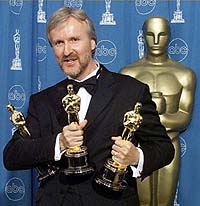
James Cameron


This is an imdb link and it's about James Cameron's filmagraphy. Cameron's debut movie is Piranha Part Two: The Spawning, 1981. The site lists all movies that he made and lists more of his famous ones like Terminator and Titanic(1997). He has three new movies in the making called The Dive, Battle Angel and Avatar.

Richard Kelly: Does He Even Have Another Film?

This is just the basic overview from the Internet Movie Data Base. It contains links to information about Richard Kelly's two shorts The Goodbye Place, and Visceral Matter. It also gives an idea of some of Kelly's achievements and other (more known) films: Donnie Darko, the upcoming release Southland Tales, and the film (currently in pre-production) The Box.


Southland Tales received almost no acclaim at Cannes when it was introduced and viewers commented on IMDB.com that it was "the greatest movie never seen." According to this one viewer, and other reviews I have read, the film tanked it and was a huge failure; trying to copy Donnie Darko but missing every beat of Donnie completely. The other clips I've included are some from Donnie Darko and from Southland Tales.

Sir Ridley Scott

Ridley Scott has a huge list of production under his belt as can be seen from the link. He has produced and directed many big budget films including, Gladiator, Kingdom of Heaven, Black Hawk Down, Hannibal, etc. His newest movie that is coming out this year is American Gangster, which is about a drug lord that smuggles heroin into Harlem during the 70's hiding the stashes inside the coffins of American soldiers' coffins, returning from Vietnam.


Free Image Hosting at www.ImageShack.us

James Cameron

This is a link that displays all of the films that James Cameron produced, wrote, and directed. A helpful feature on this page is that if you have never heard of a particular film, all you have to do is click the title of the film and it takes you to a brief summary of the film. Also there is a link on the left side of the page called biography in which it displays trademarks that are in his films. This information is very useful when dealing with an auteur or formalist approach.

Francis Ford Coppola

The following link is a complete filmography of Francis Ford Coppola. It provides all of the movies that he has directed, produced, and written, and it also provides links to each movie that describes each movie in detail. He has directed 36 movies, including those that he is still working on, and he has worked on over 130 films in various positions ranging from the writer, actor, and producer. It's obvious from just the number of films that he has worked with that he is esteemed director in the movie industry, but until you look at the movies that he has been a part of then it becomes clear about how talented this man is. His work includes such movies as Jack (1996), The Godfather Trilogy (1972-90), Apocalypse Now (1979), and Dracula (1992) - just to name a few, but he has worked with other films like Marie Antoinette (2006), Jeepers Creepers (2001), The Virgin Suicides (1999), and American Graffiti (1973). The list keeps on growing, which displays how much of an impact this man has made on the film industry.

INTERVIEW!!-Richard Kelly-Donnie Darko

This interview is pretty cool. It made me think that he made two possibilities of the film. There was a part about the director's cut that he mentioned would explain the themes in more detail. His intentions behind the film are discovered after analyzing the film, which makes it necessary to watch it more than once. Kelly quotes, "There are always questions (laughing). I think the film is designed that way to provoke an audience to think." He wants the viewers to interpret the movie themselves with slight themes that are open to interpretation.

INTERVIEW!!-Richard Kelly-Donnie Darko

This interview is pretty cool. It made me think that he made two possibilities of the film. There was a part about the director's cut that he mentioned would explain the themes in more detail. His intentions behind the film are discovered after analyzing the film, which makes it necessary to watch it more than once. Kelly quotes, "There are always questions (laughing). I think the film is designed that way to provoke an audience to think." He wants the viewers to interpret the movie themselves with slight themes that are open to interpretation.

Richard Kelly-Donnie Darko-Brief Bio

"Received only $9,000 to write and direct Donnie Darko (2001)." This is a short biography on the director of the movie Donnie Darko, Richard Kelly. His childhood seems to have a science fiction based theme. His father worked for NASA which may have been an inspiration for his idea. Unfortunatly, the underpaid set and sponsor of the film made the possibilities for more intense effects questionable. With the low pay, it is easy to give props to Richard Kelly for making the movie such an interesting point of view. The special effects and trippy scenes were still well displayed without intense visual effects. The bio also included direct quotes from the director which definatly described his personality and interests. There was a cool part about the old show Mystey Science Theatre 3000, which is such a classic show. He was influenced by the old school sci-fi stuff that the characters mocked during that tv program. His influences explain the simplicity of the directing, as well as the deep thought and artistic point of view brought to the film. This site was found on a movie database. Check it out yo!!

Saturday, March 17, 2007

Roberto Benigni

This biography of Roberto Benigni was found under the movies category of newyorktimes.com. Unlike many biographies, this biography does not dwell on Roberto Benigni's life before his career. Rather, it delves into information on his films. Roberto Benigni did not start out as a director, he began his succesful career as a comedic actor. Roberto Benigni is well known for his acting and directing of the famous film Life is Beautiful. "The movie -- which had the potentially ungainly premise of a comedy set in a Nazi concentration camp -- proved to be a huge international success, both critically and commercially. " For more information on this wacky director, click on the link.

Tony Kaye's Lake of Fire Movie Review

Tony Kaye was the director of American History X (1998). Kaye's previously documented work was a television series, Tony Kaye's Documentary (1995). American History X was the first film production by Kaye. As an amateur filmmaker he made many problems which resulted in later difficulties in film making. The link above provide a review of the film Lake of Fire (2006) directed by Tony Kaye. The review was conducted by Kenneth R. Morefield. Morefield is an Assistant Professor of English at Campbell University.

Robert Zemeckis

The link that is posted gives a quick biography of Robert Zemeckis and this link gives the filmography of all his works as a director, producer, screenwriter, and executive producer. http://movies2.nytimes.com/gst/movies/filmography.html?p_id=117906&mod=films He has been involved in such movies as, House of Wax, Castaway, Monster House, The Polar Express, and Forrest Gump. Robert has also won many awards and this link lists some of them. http://movies2.nytimes.com/gst/movies/filmography.html?p_id=117906&mod=awards

This is what the author of the article said about the movie I Wanna Hold Your Hand, which Robert directed, "despite the film's low budget, it demonstrated Zemeckis' ability to combine credible live-action sequences with elaborate special effects devices." This shows his talent as a true director.

Friday, March 16, 2007

Steven Spielberg: Director of Many...


The link provided is to Wikipedia, where it gives an in depth biography of famous director Steven Spielberg. The article goes on to explain,
Spielberg is the most financially successful motion picture director of all time. He has directed and/or produced a number of major box office hits.
It goes on to talk about his life, all the films he has created, and the numerous awards that he has received. Spielberg is best known for films that instills some sort of fear in his audience, where it be aliens, the Holocaust, or man-eating dinosaurs. This type of genre is what Spielberg is into and good at. Because of this, he has received many awards for best director (Schindler's List, 1994), best picture (Schindler's List, 1994) and Best Foreign Language Film (Letters from Iwo Jima) to name a few. Check out this article, it has many interesting bits of information. :)

Zemeckis

Academy Award-winning American movie director, writer, and producer, Robert Zemeckis, is known for his special effects reflected through his films. In the Wikipidia Encyclopedia Website, an overview of his life, schooling, career, and his interest in effects and digital film-making is discussed. Special effects include live action with animation in his film, Who Framed Roger Rabbit. Another example is in his film, Forrest Gump, where he places the main character in scenes with well-known historical figures such as John F. Kennedy. Forrest Gump is the film that won him an Academy Award for Best Director.


No other contemporary director has used special effects to more dramatic and narrative purpose...As writer and director, he has rarely allowed the show to lose sight of...human realities.
- Film Critic David Thomson


Post-Occupation Japan


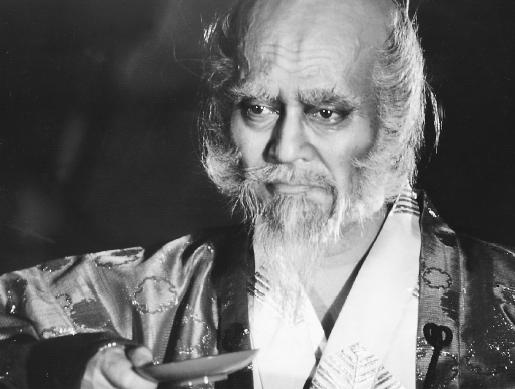
Ran, directed by Akira Kurosawa, was filmed in 1985. This period in Japanese History is known as Post-Occupation since the American occupation had recently ended in 1952. The article from Wikipedia explains that by the 1980's, the Japanese economy became incredibly strong again, and was a main contender with the USA, causing a strained relationship. Japan had also become a major supplier of arms to the United Nations during the Korean War and despite its agreement never to have an army again since WWII, Japan had built a Self-Defense Force. This was with strong encouragement from the United States due to the growing tensions of the Cold War with The Soviet Union. The period, though prosperous for Japan, is marked with increasing tensions between many different nations.

Thursday, March 15, 2007

Tony Kaye's "Lake of Fire"

In this article written by Richard Porton, he discusses movies including Tony Kaye's "Lake if Fire" movie. In this article he discusses some of the apparent styles of directing that Kaye seems to use throughout his movie productions. He states how this production by Kaye was considered to be a challenge to him because it was difficult to classify into a specific genre.
Although nothing approaching the stature of Thom Andersen's Los Angeles Plays Itself emerged this year, one nonfiction film, Tony Kaye's Lake of Fire, could only be labeled an unclassifiable conundrum since Unraveling its frequently opaque argument posed a real challenge.

Tuesday, March 13, 2007

Historical analysis of Schindler's List

Yosefa Loshitzky writes about Spielberg's movie "Schindler's List." He challenges if the movie really is historically correct and if the Hollywood version of the Holocaust is correct. He discusses the books historians have written about the genocide, and if the history of the event matches up with the dramatized version of the horrible event in Spielberg's film.

Robert Zemeckis

This site gives background information about the director of the 1994 film, Forrest Gump. Originally from Chicago,Robert Zemeckis is a top director in the film industry; he has made dozens of movies, many of which have been box sellers. These best sellers include Back to the Future 1, 2 and 3, Cast Away, I wanna Hold Your Hand, Who framed Roger Rabbit, What lies Beneath and many more. However, Forrest Gump was one of his biggest box office smashes.
It took Zemecki a couple of movies to finally make a great film. He even worked with the great American film maker, Steven Spielberg on numerous occasions. In his Films, he always uses a pop culture theme focusing on American life. He not only directs films, but he also produces them. His films touch the hearts of millions and there will be many more to come.

"Characters Who are Wandering"

In this insight review by Kim D. Hester-Williams on the famous film THE GREEN MILE by director Frank Darabont. Kim's review says that concepts or ideas are "Wandering in the Dark". Coincidently, THE GREEN MILE is also depicted from a Stephen King novela with the same title. This review touches on issues such as genre. Some of the suggested genres that Hester-Williams speaks off are refering to the film as a Horror or a Sci/Fi. Why? Well, she says that it is due to some suspense scenes with scientific explications(read review for more information). Other issues addressed were such like the relationship between the inmates and the guards. The movie is trying to explain the similar parallels between these two characters during this era of the Great Depression.

One comment by Kim says, "Both King and the filmmaker, Frank Darabont; consistently romanticize Coffey's suffering by offering up a story where readers and viewers are directed to concentrate on the mysteriousness..... and not the racial oppression that he suffers."

I highly recommend this review that is similar to our movie patterns in The Shawshank Redemption.

Tony Kaye

This article is about the "director" of American History X, Tony Kaye, and was found on Wikipedia. The funny thing about Tony Kaye is that he doesn't want to be known as the director of American History X, and didn't even want the movie released. However, after all the fighting with The Directors Guild, and other organizations, the movie came out with his name down as director. Kaye doesn't have much directing experience, but has a couple of movies that will be coming out soon. Wikipedia touches on the the ontroversy behind him, among other things.

Interview of Robert Benigni

The article I am linking to is an interview of Roberto Benigni by Adrian Wootton. Like any interview, Wootton asks Benigni a few questions about his childhood, first performance, other influences in life and so on. The reason I chose this article is because the story of Life is Beautiful parallels Roberto Benigni's life. Benigni "grew up in Tuscany in a very poor family... but [his] childhood was very good... because it was full of gladness and good humanity." The characters in Life is Beautiful are relatively lower class but that does not stop them from enjoying life and being happy for what they have. This interview makes the viewer understand why Benigni makes the types of films that deal with real life issues but with a twist of comedy. Clicking on the link above should take you to the reading.

Monday, March 12, 2007

Postwar Samurai Films of Japan

Allen White, screenwriter and film journalist for GreenCine, writes in this article about the Samurai film immediately post World War II, when the genre most prominently developed. The article is a mix of consideration of Japan in that period and how it dealt with film making, as well as an exploration into this somewhat obscure genre. The article focuses on the particular era between the beginning of MacArthur's occupation of Japan through 1970 and hence includes mention of Rashomon and Seven Samurai, but it can also be used to understand post 1970 Japanese films as just an analysis and context on the genre itself.

The Depression South and "O Brother, Where Art Thou?"

Charles Taylor, film essayist and current film critic for salon.com, writes about the depiction of the Depression South of the 1930's in the Coen brothers' O Brother, Where Art Thou?. He admits having mixed feeling for the performance of the actors, as well as the film itself, but overall tries to understand the film as a depiction of the 1930's, and the characters you might find then in the south. As Taylor writes about th movie,
The Coens don't want just to call up the Depression South, they want to bask in it a little.

Perhaps he was right, Taylor makes sure in his essay to mention the influence of the abundant amounts of American art which seem to come from the same era, and this certainly reflect the kind of art he was writing about.

The Mafia Genre

The Mafia genre can be seen in many movies today, but one of the greatest movies in this genre is The Godfather. In this article written by Murray N. Rothbard, he discusses this genre and the difference between The Godfather and Goodfellas. The success of the Mafia genre can be seen by the "realization and dramatic portrayal of the fact that the Mafia, although leading a life outside the law, is, at its best, simply entrepreneurs and businessmen supplying the consumers with goods and services." Rothbard states that the violence depicted in The Godfather should not be taken the wrong way because it is "productive and non-aggressive," while unorganized crime is "punkish and viciously aggressive against the innocent." He also talks about the difference between The Godfather and Goodfellas. Rothbard mentions that The Godfather stays true to its genre because Goodfellas has many contrasting aspects, such as the punkish crime and random violence, which is not true to the ideals of a Mafia. The Godfather depicts its genre of family and Mafia excellently, but still many people fail to realize the true meaning and portrayal of the film.

The Shawshank Redemption

In this link, the author discusses a general overview of The Shawshank Redemption, and mentions the different themes discussed in the film.

The author states that the film deals with perseverance and sacrifice, but also about joy and hope.

The author also discusses how the director, Frank Darabont, keeps his work simple by using "by-the-book structure" and techniques for this film.

The author ends by stating, "It’s all about how Earthly friendship and human connection are crucial for the heart, but faith – in whatever form – is good for the soul. That’s why Shawshank has found such a universal audience connection: because it expertly uses a straightforward moral-bound story to carry such weighty baggage."

The Best and Worst of Science Fiction

This IMDB page rates Science Fiction films and displays the best and worst in the genre. the voters have Star War: Empire Strikes back at the top spot. our film, 2001: a space odyssey, ranked at 7. The films at the bottom of the scale I've nee heard of, which is probably why its at the bottom. i don't agree with some of the rankings on the list but that's just my opinion

Sunday, March 11, 2007

2001's effect on the sci fi genre

The second section of this page talks about how kubrick's film, 2001: a space odyssey, changed the standard for sci fi. The author says that the film engages the viewer in different ways. It emphises the setting and allows the viewer to absorb the scene.

Science Fiction

In J.P. Telotte's book called Science Fiction Film, it discusses the basic foundation of the science fiction genre. It makes a sort of connection to the science fiction genre and real life science. Telotte quotes legendary pulp editor John W. Campbell Jr. by saying " science fiction should be the effort to predict the future on the basis of known facts." Telotte also adds "science fiction often seems to appeal precisely because it lends itself to the greatest imaginative capacities of the film medium: special effects." This is a useful peice of writing that can help clarify one's understanding of the science fiction genre.

The History Behind Braveheart

The movie, Braveheart, is based off of the legends about the life of William Wallace-a Scottish national hero. The link I provided is found on the MyGenealogy website, which provides a lot of historic information on past wars around the world. The article regarding the history of Braveheart is titled, The History Behind Braveheart. During the early 1300's the Scottish struggled to fight for their independence from the English. The film surrounds the story of William Wallace, a Scottish hero who decided to fight for the freedom of his country against the English. He slowly gathered a large group of followers to defeat the English rule. As illustrated in the movie, Wallace and his followers defeated the English army at Stirling on September 11, 1297. Unfortunately, on July 22, 1298, King Edward II led a large English army against Wallace at the battle of Falkirk. Wallace was captured and taken to London where he was executed on August 23, 1305. Although Wallace was not able to free his country from English rule, he inspired others to carry on the struggle for freedom. Following the death of Wallace, Robert Bruce, a Scottish fugitive, was inspired to fight for the freedom of his country, and was crowned king of Scotland. On June 24, 1314, Bruce led and army of 40,000 troops to fight against the English army of 60,000 troops led by King Edward II at the Battle of Bannockburn. As the English launched a mass attack against the Scottish, Bruce had prepared camouflaged pits in the ground that allowed his troops to slain the English as they fought to attack. The English were defeated and lost about 10,000 men. This battle marked the Scottish independence from the English.

Death Penalty in The Green Mile

The film The Green Mile (1999) takes up the controversial issue of the death penalty. During the mid and late 90's, the number of executions taken out by the United States had dramatically increased reaching a high of 98 executions in 1999. this was carried out by a nation which, by the mid 1970's declared an abolition of the capital punishment. This article is featured in the Prison Film Project website where it discusses the reaction of the increased death penalty rates through different hollywood films.


"Death penalty films of the 1990s tended to reproduce rather than challenge the notions of criminality that underpin a belief in the death penalty in contemporary America."
-Austin Sarat

Saving Private Ryan: The History Behind Omaha Beach


Saving Private Ryan is filled with many memorable scenes and they will be mentioned in film classes for years to come. Yet, the most fascinating scene, and possibly the greatest scene in the "war" genre, is the arrival of the American troops on Omaha Beach. With the amazing Steven Spielberg at the helm, the scene really captures the essence of D-Day and is portrayed in a way that no other film has been able to. The fact is that as amazing as the scene appears, younger generations may not understand the purpose of the invasion of Omaha Beach in World War II. If the audience does understand the significance of the invasion, they may not understand why American troops were so easily disposed of on that day. I, sadly, was one of these people that did not comprehend the whole concept of the Omaha Beach invasion in an historical context. As a result, I did some searching and found an interesting website that speaks about the historic event that happened on that beach and logistics of the terrain that the troops were on. The entire page was written by World War II historian Brian Williams and was featured exclusively on the Military History Online website.

History Behind Schindler's List


The link provided gives an in-depth summary of the Holocaust, which is the event that the movie Schindler's List focuses on.
During World War II, Nazi Germany and its collaborators murdered approximately six million Jews. The Holocaust is the name used to refer to this systematic, bureaucratic, and state-sponsored campaign of persecution and murder. Beginning with racially discriminatory laws in Germany, the Nazi campaign expanded to the mass murder of all European Jews.
Schindler's List helps the audience grasp what was going on and tells its story through the perspective of Oscar Schindler and some of the Jews that were captured. For the film Schindler's List, experts on the Holocaust were brought in to make sure the film stayed true to historical facts. The nice aspect about the link I provided is that it lets you click on keys words surrounding the Holocaust and goes into further detail on each of those words. For example, you can click on "concentration camps," and the site will take you to another page that deals only with different concentration camps and how they were used in Schindler's List.

Science Fiction Genre

This site explains what the genre science fiction is. This site says that science fiction are
complete with heroes, distant planets, impossible quests, improbable settings, fantastic places, great dark and shadowy villains, futuristic technology and gizmos, and unknown and inexplicable forces.
The site is pretty good with explaining the genre since it goes on to explain it through examples of movies, and it lists a tons of movies. Each time a movie is listed, an explanation is followed where it explains what made the movie science fiction.

Kingdom of Heaven (Historical Article) By Steve Bochra


In this website you will find a critical article performing genre analysis. Thomas F Madden criticize Kingdom of Heaven movie. Thomas F Madden is fascinated of the movie and he mentioned that the film is filled with medieval battle. He said “The film can best be described as a series of bloody medieval battle scenes stitched loosely together with a thin, yet preachy, modern morality play”. Madden mention that Kingdom of Heaven shows some reality of the middle ages aspects. Madden stated “They haven’t. In fact, there is very little that is medieval about The Kingdom of Heaven. It is instead a mixture of 19th-century Romanticism and modern Hollywood wishful-thinking”. Madden affirmed that the film touched a historical fact which shows the Crusades of Muslim invasion of Christian land.

Official! "What Mad World?"

Jason Cowley wrote Official! It really is a mad, mad, mad world. For the "Newstatesman" which was published January 5, 2004. The majority of the article summarizes the writing of Roland Orzbal's memorable song "Mad World". But an excerpt from the article talks about how the song was re-recorded for Richard Kelly's 2001 release Donnie Darko. Cowley dicusses how "Mad World" adds to the 1980's feel of the film and how the rest of the soundtrack further pushes this ambience along.

"[Mad World's] success, though perplexing, is partly the result of the startling effect of the film Donnie Darko. Though greeted with indifference on its release in America in 2001, Donnie Darko has since acquired cult status... everythird person you meet rcommends [the film]."

The 1980's theme of the film is again seen with the opening discussion of Bush vs. Dukakis. Cowley also incquires into how the overall effect of the film is represented by the music chosen for the soundtrack.

Historical Events that Relate to American History X

This article discusses the life of Neo-Nazi's including symbols, beliefs, and organizations. This article also includes background information and a brief history of the Neo-Nazi movement.This article relates to American History X, because the main focus of the movie deals with and ex Neo-Nazi and how he tries to reconnect with his family after serving time in prison. Also he tries to save his brother who is beginning to follow in his past footsteps.

Events around Pulp Fiction

The movie "Pulp Fiction" was release in 1994. This is the same time that the infamous OJ Simpson trial was taking place in California. The extent to which people were interested in this criminal investigation and trial can be judged from the following quote,

"Although the 1995 criminal trial of O. J. Simpson for the murders of Nicole Brown Simpson and Ronald Goldman has been called "a great trash novel come to life," no one can deny the pull it had on the American public. If the early reports of the murder of the wife of the ex-football-star-turned-sports-announcer hadn't caught people's full attention, Simpson's surreal Bronco ride on the day of his arrest certainly did--ninety-five million television viewers witnessed the slow police chase live. The 133 days of televised courtroom testimony turned countless viewers into Simpson trial junkies. Even foreign leaders such as Margaret Thatcher and Boris Yeltsin eagerly gossiped about the trial. When Yeltsin stepped off his plane to meet President Clinton, the first question he asked was, "Do you think O. J. did it?" When, at 10 a.m. PST on October 3, Judge Ito's clerk read the jury's verdict of "Not Guilty," 91% of all persons viewing television were glued to the unfolding scene in the Los Angeles courtroom."

The movie pulp fiction also deals with crime like the Boss who supposedly killed a guy who massage his wife (Uma Thurman's) feet. But I think the other debate that raged because of the OJ Simpson trial was about race. There are claims that the trial had been tainted by race. If we look closely in the case of Pulp Fiction, we see there are racial overtones that Tarantino has carefully built into the movie. One scene in particular happened when the boss and the boxer (bruce willis) end up in a store in a sequence. The door has the confederate flag on it. But the thing to note in there is the store owner (and his police buddy) sexually assault the boss (a black) but leave alone the character of Bruce Willis. I think what Tarantino might be trying to accomplish by this is to show us that there still are racial barriers that exist between different groups even after all these years.

The author of the website is Douglas O. Linder from the Univ of Missouri - Kansas School of Law.

Whaddya Look at? Re-reading the gangster genre

This movie is talking about the "Godfather" but I think it is relevent since my movie Pulp Fiction is also a gangster crime drama. The article goes character by character of the Sopranos and sees how it all fits in the crime gangster genre that, in this case, Godfather belongs in. The article is written by Martha Nochimson who studies the gangster genre in Hollywood. The article is linked from the JSTOR database available through the UIC library.

The following quote from the beginning of the article very nicely tries to sum up the gangster genre:
"Perceived as hypermasculine fare, the gangster picture is generally understood to be popular because of its explosive virility and its close connection to reality. Yet despite these entrenched truisms, hindsight and the progeny that have been spawned by the early masterpieces of the genre suggest that the situation is more complex."

Historical Events which influenced American History X


http://www.fatherryan.org/holocaust/neo-nazi/backgrnd.htm

The second link I have presented provides insight to the background and brief history of the neo-Nazi Movement. American History X (1998) was a racially charged movie which had two main characters which followed the beliefs of the neo-Nazi Movement. The neo-Nazi Movement on the other hand was a result of the Holocaust. The first link gives a Holocaust Timeline of the events which occurred beginning in 1933 leading up until 1961.

A Case Study of Donnie Darko,Analysing Interpretations and its Cult Status

Matthew Kenneth Bishop takes his time analysis the very complex and twisted movie Donnie Darko. He makes many claims as to a certian and peticular genre that he would classify and eventually the film, Donnie Darko. Bishop aslo takes time to refrence a historical and poliical aspect of the film; the 1988 United States Presidential Election. somehow he convincely categorizes the mere refrence in the film as hopeful act to add depth to the chracters of the story. The following qoutes, I feel, play a significant role in both this writng and as well as in my final paper and most defintely plays a key role in the understanding of the six methods of analysis. A Case Study of Donnie Darko,Analysing Interpretations and its Cult Status is a bold dissertation on the logic of Donnie Darko.


"This time setting also lends itself well to the narrative, as Kelly uses a number of popular cultural references that add a further level of depth to the characters. The political debate within the Darko household separates Elizabeth from her father.
This paints her in a rebellious, yet not extreme, light with her support for
Dukukis lacking solid political argument, seeming to exist just to bait her father
who is supporting Bush."

"It is interesting to note also the genre that Donnie Darko would fit into. This is a difficult film to categorise by genre as it contains elements of so many, all of which help contribute to its complex meanings and difficulty interpreting it. It can be seen as a teen rite of passage film, with Donnie trying to understand his life, embarking on what is essentially a journey of discovery, not dissimilar from the journey of Brad and Jane in The Rocky Horror Picture Show. The romantic element between Donnie and Gretchen, and the science fiction elements are prominent. There is also an addition of horror genre, not least, as it is set around Halloween, which allows Frank’s image to fit in well with the season. The twisted rabbit mask could be
something straight out of a horror set piece. Coupled with the deranged look of Jake Gyllenhaal after speaking to Frank, it is harrowing after seeing some comedy scenes, such as the discussion about the sexual appetites of the Smurfs(another 80s popular cultural reference). This variety of different genres becomes a key factor in the analysis of Donnie Darko as a cult film, as the multi-faceted genres can be seen as a key attribute of cult status."

Historical Memories of Forrest Gump

"A Struggle of Contending Stories: Race,, Gender, and Political Memory in Forrest Gump" by JenniferHyland Wang(a journalist at the "Cinema Journal) talks about the historical shots in Forrest Gump viewed by conservatives.Quoting Wang, "As the political pendulum swung toward a"new conservatism:, Forrest Gump played a critical role in the rearticulation of a traditional version of the American Story. Through its representation of genrer and race and its re-presentation of the 1960s, the movie effectively revise popular memories of the era." The history of the film plays a big role in contributing to the sucess of the movie, along with the idea of conservatism in the re-vised history; created by Forrest Gump.

History Behind The Godfather

This link provides a short historical analysis of the The Godfather by stating that the film depicted "poverty, the turn of the century, a family, and the hypocracy of politics in America." Also, the link refers to The Godfather as an accurate portrayal of the Sicilian Mafia through the language and culture. However, this links doesn't give an indepth historical analysis as it does link the movie to key figures and events during the '20s. The link goes into descriptions of which characters in The Godfather resembled real-life gangsters, such as Johnnie Fontaine is most likely a link to Frank Sinatra, who was suspected of having mob connections. Also, Moe Green and Hyman Roth, in the movie, was closely related to Bugsy Siegel and Meyer Lansky because of the related deaths and roles within the movie.

Saturday, March 10, 2007

The Lady From Shanghai

Everyone knows the genre of horror, action, drama, romance, and comedy. Many people, though, do not know the genre of film noir. Film noir was very popular in the past, but not seen so much today.

The movie The Lady From Shanghai, is an example of film noir, starring and directed by Orson Welles.
The Lady from Shanghai is adroitly punctuated by many of the genre’s conventions, and viewers will be hard pressed to find a more impressive and thorough film noir.
This article really analyzes how this movies fits into the genre of film noir. Usually a film noir has a leading character that is usually a female called the femme fatale. Most are in black and white and usually have a voice over narration by the main protagonist who usually is a detective.


Forrest Gump- A Fictional Character

In the article, Forrest Gump: A Controversal Approach of American History, is an article dealing with historic events in the movie Forrest Gump. The article is written by Ludovic Courtes, from the George Washington University. He states in his article how various events taken in the film can be a controversal argument. An example Courtes has used from the film is when Forrest reveals the political scandal of the Watergate. Courtes also says that Forrest is a fictional character and the movie shows us how he deals with certain trauma events in history.


From the movie, one can get the impression that the author tried to have him movie embracing a whole part of the American History by just showing it through the eyes of a fictional character.

Effects of the Cold War

This is a link to a brief summary of the Cold War and the effects it had on the people of the world.  This relates to our movie Terminatory 2: Judgment Day because the movie is about the threat of nuclear arms and technology.  In the movie, Judgment Day, or doomsday, occurs when machines take over and launch a series of nuclear attacks to eliminate all humans.  This movie came out in 1991, which is very close to the time of the end of the Cold War.  At this time, people were still paranoid and frightened of the term nuclear bomb.  Although no bullets were fired during the Cold War, it was a very tense and frightful period in U.S. history.

RELIGION & POP CULTURE

Anton Karl Kozlovic explains how "Christ figures" are built-in to Hollywood films.

Karl says, " christ figuress describe any figure in the art who resembles Jesus."

Kozolovic goes into more depth on this Christ representation by saying that christ figures go on to represent HEROES.
Another interesting point is how filmmakers bring in this "Christian imagery" for commercial reasons, knowledge...and so on.
An interesting point about the Hero figure Anton says,

" I must say that BABE is much closer to a christ figure than max. particularly in Babe( Dir. Chris Noonan), he doeschange the established order, In fact, in Babe,Pig in the City he's much more a Christ figure because he turns the other cheek. He goes to save from drowning the one who was about to kill him....."

Anton brings alot of very sophisticated issues about Christ figure influences.

Friday, March 9, 2007

COMEDY FILMS


Roberto Benigni's film, Life is Beautiful, not only serves as a historical-type genre, it is also a comedy. I chose to provide a link to a website that discusses and deconstructs the genre because it provides the reader with excellent information on a critically over-looked genre.

Tim Dirk's website, www.filmsite.org, provides an explanation of a famous genre called "comedy." It defines the genre of film comedy as "make 'em laugh" films designed to elicit laughter from the audience. Comedies are light-hearted dramas, crafted to amuse, entertain, and provoke enjoyment." Like many genres, comedy possesses many forms. A few of these forms include: slapstick, dead pan, and verbal comedy. This site provides an extensive list of the different forms of comedy present in the comedy genre. Filmsite.org not only defines the many types of forms, it also provides an example of each. Here is an example from the site:

Black or Dark Comedy:


These are dark, sarcastic, humorous, or sardonic stories that help us examine otherwise ignored darker serious, pessimistic subjects such as war, death, or illness. Dr. Strangelove serves as an example of this type of comedy.

For more information on the comedy genre and its many forms, click on the link. Enjoy the laughs!

Thursday, March 8, 2007

Gladiator's Commodus vs. the actual Commodus

The movie Gladiator, for those who have never seen it, is about a very respected general of the Roman Empire who is exiled by the new ruler Commodus. The general is captured and sold as a slave. He finds himself soon fighting in arenas as a gladiator against other men and animals. Eventually he fights Commodus in the arena and kills him.

Free Image Hosting at www.ImageShack.us


Commodus was a real emperor of Rome. His full name and title is Caesar Marcus Aurelius Commodus Antoninus Augustus. He was a very brutal ruler who had many senators killed after an attempt on his life and ordered the execution
of his chief advisor to please the army, and the successor was killed in a riot. He started to lose his mind and pretended that he was Hercules entering the Colosseum to fight gladiators and animals. On December 31, 192 AD, his advisors had him strangled by a champion wrestler.


Free Image Hosting at www.ImageShack.us

Braveheart: Fact or Fiction


In response to the popularity of the blockbuster Braveheart, Scottish historian Ewan J. Innes replied, "One of the most common questions I'm asked is how factual Mel Gibson's portrayal of William Wallace was in the 1995 film Braveheart. The short answer is that is hasn't an iota of fact in it." Continuing Innes explained, "It's a good film, just don't take it as fact... For example, Isabella cannot have been carrying Wallace's child (and presumably Edward III) as she was in France at the time and did not arrive in England until two years after Wallace's death. She could also therefore have not warned him at York (which Wallace didn't attack anyway)."
Another fault in the films historical accuracy is its interpretation of the battle of Falkirk. While the film conveys a much more heroic approach, in actuality "Wallace escaped the field but the majority of the Scottish army did not. Bruce was not at the battle as he was in Carrick in the southwest at the time."
Following the Battle of Falkirk, Wallace "resigned as Guardian and was sent on a diplomatic mission to France and Rome. He did not return until after the Scottish surrender in 1302." Yet, another example of the film's skew on historical events. Although Braveheart cannot serve as sufficient history source, the film's themes of freedom, romance, and integrity uphold its popularity. While, historians due tend to find flaws in th films accuracy, its only fair to note that the movie does open with the line "[history has been] written by those who have hanged heroes," which strikes wonder.

Braveheart- A look at the many sides of the film


Filmsite.org states the following for war genre films:
Themes explored in war films include combat, survivor and escape stories, tales of gallant sacrifice and struggle, studies of the futility and inhumanity of battle, the effects of war on society, and intelligent and profound explorations of the moral and human issues.


Bravheart has many of the necessary elements to be an action-oriented war film. The most recognizeable aspect of the film, in regards to what Filmsite mentions, is Wallace's uncanny ablility to escape or avoid altogether situations that may cause his death. He survives numerous battles and at least two assassination attempts due to the influence he had over people. However, there is a theme of male-bonding in the film, when Wallace and his lieutenants are sitting around the fire eating, and they feel comfortable enough to make racy jokes about one another.

Historical Events

Also, the film makes reference to many historical events in the film, such as the Battle of Stirling Bridge between the armies of England and Scotland. In the film, the battle takes place nowhere near a bridge, being as it would have been to hard to film such a big battle in such a restricting setting. Also, the "battle" was more of an ambush of the english, not an instance where the two armies lined up facing each other and charged, according to wikipedia. There are a number of historical inaccuracies in the film. These inaccuricies resulted from the flim being changed in order to give the movie a better outcome. The details may also have been altered due to the fact that the basis of the film is from a poet named Blind Harry, who wrote the poem some time after Wallace's death. Whatever the reason for these inaccuracies, they remain in the film nevertheless, altering the perception of many who view the film, obscuring their knowledge of histroy.

The article on Bravheart can be viewed at this web address :
http://en.wikipedia.org/wiki/Braveheart

Science Fiction Film History

The Wikipedia Encyclopedia web page that is linked to above contains information on the science fiction film industry. It has a long list of sci-fi films in order by the year they were released, starting in 1902 up until recent films of today. Each film listed has a link that will give you more detail for that particular film. Although sci-fi films first appeared in the early 1900's, they did not achieve a significant audience with respect to the entire film industry until the 1960's. Groundbreaking sci-fi films such as 2001: A Space Odyssey and Planet of The Apes were two of the vastly popular films that come out in the '60s that would "transform science fiction cinema." Since the sixties sci-fi filmmakers have been at the front line of special effects technology and development. The massive number of sci-fi movie fans are said to be kept interested by the themes of the films. Themes such as space travel, paranoia(man vs. machine, man vs. evolution), disaster(Armageddon), and the new-age cyberpunk(The Matrix) genres have all been big hits at the box office. The science fiction film industry has grown tremendously over the past century.

Wednesday, March 7, 2007

Crime Genre in The Godfather


The Godfather is a film which is highly focused on the American crime film and gangster genre. The story is based on an Italian gangster from a poor working class background that transforms himself into a social underground king through illegal means. the story focuses on law and order and how the hierarchical social structure is maintained. In order to establish an American crime film, the characters and plot needed to link together. The main character had to show the audience his ruthlessness and greed to secure the American dream of material success.

"The conflicting prosocial and subversive elements within the gangster genre give rise to contradictions that cannot easily be given away."

The Auto-Industry and Terminator 2


In this post you will be made knowledgeable about the brief history of the auto industry. This post gives a timeline of the auto industry from the years of 1960-1998. Under the year 1980 its states "Japan emerged as the world's leading producer of automobiles with just over 11 million units produced in a world-wide total of over 38.6 million." This is interesting to me because it relates to a statement in the article, Termination or Transformation (my summarization article) . In this article it states that "U.S. auto manufacturers adopted methods, which they assumed accounted for the success of Japanese industry." This brief history relates to the Terminator 2 because it ties into the movie and how auto manufacturerers tried to replace humans with robots. These manufacturers thought that robots would be more beneficial, since they couldn't get hurt on the assembly -line. Also the robots they thought could perform more challenging tasks, without any complaints. Without being said the manufacturers believed the robots would bring more income to the auto industry.

Sci-Fi Films


Science fiction (Sci-fi) films are those in which are, of course, scientific and portray advanced technology/gadgets (robots i.e.), great imagination, etc. In these films we may see things like flying cars, cloning, futuristic events, just the impossible (or at least for now). The Terminator 2 ties into this genre, because of the visuals of robots and cloning. In T2 we see the Terminator become the clone of anyone he comes into contact with. Other great examples, of this genre includes Blade Runner, Frankenstein, and Star Wars.

Prison in Film History

(Top picture is from The Big House (1930). The bottom picture is from Shawshank Redemption (1999).)
This article briefly describes David Gothier Jr.'s book, "American Prison Film Since 1930: From The Big House to The Shawshank Redemption". The book gives a historical analysis on well known prison films. Gothier believes that prison films have their own separate genre, which has been falsely compared to western, horror, and gangster films.
The article goes on to say that
"the prison movie is perhaps the only pure-bred genre that yields so many other genres within its original framework: gangster prison films (The Big House), film noir prison films (Brute Force), western prison films (There Was a Crooked Man), sports prison films (The Longest Yard), science fiction prison films (Escape from New York), the POW film (Stalag 17), even musicals (Chicago)."

The base of the book deconstructs in great detail twelve films, including Shawshank Redemption, based on the rules of the prison genre.

Tuesday, March 6, 2007

Historical Events in Donnie Darko


The unique film Donnie Darko takes place in the year 1988. This particular year had a lot of relevance on our country's political history. The year of 1988 was when the Bush vs. Dukakis election campaign took place.
Nicholas Katers, the author of the article "Election of 1988:Bush, Dukakis, and the Liberal Democratic Failure," is a history graduate and has published work in published in SEAC's Threshold magazine, Generationvote.com, Internationalist Magazine, and ten academic works. This particular article was published on www.associatedcontent.com, which is a site for various types of media.
The election campaign of Bush vs. Dukakis not only took place in the time period that Donnie Darko is set in, but there is a scene in the movie where Mr. Darko, Donnie's father, is watching the election campaign debate on television. Even though this is the only scene that visually displays the Bush vs. Dukakis election campaign, the film sends a message about the politics of 1988.
The article, "Election of 1988:Bush, Dukakis, and the Liberal Democratic Failure," discusses the conflict and hostility that was present throughout the fight for presidency. Nicholas Katers states that
"Bush, no stranger to negative campaigning, took every opportunity to discredit Dukakis as a dangerous and radical liberal."
Bush played a very competitive role in order to win the position of presidency. According to the opinion of Nicholas Katers
"Dukakis attempted to play the role of patriot by riding in a tank but he looked more like a little boy playing general than a potential commander in chief. Dukakis’ attempt to walk the line between liberals... and moderates...failed to get the party out from under the popularity of the Reagan-Bush administration."
This article displays how rough the competition was for the presidency.
The fact that the movie included the campaign shows how relevant this election was for the time period of the film. Donnie Darko uses symbolism to express views of our country's political state and redefines what it means to be Left. The film expresses a low opinion for the democrats and does not approve of the Dukakis candidate.

Historical Analysis-Popular Culture

This article has a lot of links that can be used to analyze our contemporary american culture. The copyright was T.V. Reed also connected to an American Studies website/group. The body of the website includes links to film culture as well as issues in our everydays lives (ex. race, class gender, imperialism, sexuality.) Here is a quote describing the main points of the site:
"We cannot understand our present without understanding our past. And we cannot fully imagine change without a sense of how our culture has changed over time. Our ability to understand the improvements in and the limits of current media representations of African Americans, for example, is greatly enhanced by viewing two documentaries that detail the history of African American representations in the mass media, Ethnic Notions and Color Adjustment. "
With most examples of a historical analysis we see how the film or other form of entertainment was perceived through the general public. This site allows you to see the dates and opinions of people living in America during the time each film was shot.

Right of the First Night


In the movie Braveheart there are many references to actual historical events. Although some of William Wallace's triumphs are historically debatable, the legislative his motivation is stirred from is recorded as customary throughout Medieval Europe . In Braveheart William Wallace refuses the imposed law of jus primae noctis, or "law (or right) of the first night", which would give an English lord jurisdiction to deflower his bride on their wedding night. While marrying in secrecy to bypass the law seems like a good idea to Wallace at the time, it still doesn't keep his bride away from the sexually aggressive attitudes of the English. This act reflects the ideology of the strictly enforced social hierarchy of the time, which reigned god, king, lord, knight, etc. throughout Europe. Jus primae noctis is viewed as a continuation of this distinction by its reflection as as another "power display with a basis in the psychology of coercive social dominance, male competition, and male desire for sexual variety." In reference to Braveheart, this masculine power display becomes what incites Wallace's fight for love and freedom.

Life is Beautiful portrays history?

The article, "Not Up To The Task", written by David Walsh, criticizes Life is Beautiful for not accurately portraying the Holocaust. The article begins by summing up the entire movie and giving background information on each character. As the article continues, Walsh starts to get more into his argument and explains why this movie is not a true depiction of the Holocaust. He believes that "while [the movie] may not be offensive, it does tend to trivialize the experience. The gap between the reality of concentration camp life and its portrayal in the film is alarmingly large." Walsh believes that Roberto Benigni, the director of Life is Beautiful, does not show how the Holocaust really was. He makes convincing arguments about how there are certain characters who "despite conditions of near starvation, [remain] happy and healthy." This article is a good read because it compares how the Holocaust really was to how Roberto Benigni misinterprets the historical event in his movie. Clicking on the link above should take you to the article.

Monday, March 5, 2007

The Passion of the Christ

The movie "Passion of the Christ" directed by Mel Gibson was a movie that raised a lot of questions. The author of the article was Ched Myers. He is a activist theologian and he feels that is is come of his responsibility to defend the gospel against contemporary representations and reproductions that he judged to be particularly wrongheaded or dangerous. In the article he offers another way or reading the story of Christ arrest, trial, and death. He breaks it down into 5 parts: The Arrest, The double-trial, The first trial scene, The Second Trial scene, and The powers killed Jesus. In the end he says that the focus of Gibson's film is how Jesus died but that the real question is why Jesus was put to death, and he says that "that story would be a movie worth making."

American History X: An Ideological Analysis


"American History X: A Critical View of the Movie" is a critical article written by Eric Loveday that focuses on the ideology of the film American History X. The piece was written exclusively for the Associated Press website. As many of us know, American History X is a very controversial film that focuses on several immense issues that currently exist in America. Eric Loveday points out two of these ideological issues by stating what the themes of the film are. The first thing he points out is that this film is built around the ideas of racism and white supremacy. He says that this theme helps the audience to realize that white supremacy groups are still very active and have a certain amount of strength even to this day. The other major theme that he points out is that politics is the fuel to the racism inferno. In short, Eric states that the government withholds jobs from white people. Therefore, they retaliate for this "unfair" treatment. I feel the following quote conveys the idea of Eric Loveday's entire article.
"The government is to blame for much of what is wrong with society today. Derrick blames the government for letting illegal immigrants come to our country and for letting them steal jobs from the whites within this country."

Music in The Royal Tenenbaums


In this critical essay found on www.senesesofcinema.com, Carole Piechota argues that the music in mise en scène naturally takes over the other elements. In The Royal Tenenbaums, she says, the feelings for the siblings Margot and Richie are best described and transferred to each other and the audience via popular music. "The most sophisticated articulation of Richie’s and Margot’s grief and longing are expressed through the lyrical content, instrumentation and associated imagery of three specific songs," says Piechota. Ultimately, music not only transfers their emotions, but "absolves" them.

Sunday, March 4, 2007

Donnie Darko - Ideology

Donnie: "I could spend my whole life debating over and over again, weighing the pros and cons, and in the end I still wouldn't have any proof, so I just don't debate it any more. (laughs) It's absurd."

Dr. Thurman: "The search for God is absurd?"

Donnie: "It is if everyone dies alone."

The link I provided is an extensive crtical/ideological analysis of the movie Donnie Darko. Lawrence Person takes his time analyzing the film's many different chracteristics. lawrence touches on ideas of the philosophy of time travel and the tangent universe carelessly labeling it as "wacky shit." Lawrence states that Tangent universes are inherently unstable, lasting only "a matter of weeks," eventually collapsing in upon themselves, each one "forming a black hole within the Primary Universe capable of destroying all existence. it seems that lawrence feels that the values represented in this scifi thriller are ones of uncertainty and life is merly useless and boring.

Lawrence Person's short fiction and poetry has appeared in Asimov's, Analog, Fear!, and the anthologies Alternate Presidents and Horrors! 365 Scary Stories. He edits the Hugo-nominated critical magazine Nova Express.

Ideology in Disney


According to journalist Jessica Tiffin of the Marvels & Tales journal, many Disney films represent larger issues, and often relate to topics of "Family, Women, Culture, Literature, [and] History." For example, Tiffin acknowledges Shakespearian references in films like The Lion King to Shakespeare's Hamlet, as well as incites "Richard Finkelstein's tracing of parallels between The Little Mermaid and The Tempest." Tiffin relates The Emperor's New Grove as another film of historic reflection, in which Disney neglects the scholarly approach by producing a film of "cultural imperialism or problematical ideology." Finally, she concludes by citing another example of Disney's relation to current events through "Diane Sachko Macleod's exploration of Aladdin," in which parallels of the Gulf War and this film have driven criticism.

Whether or not these connections are accurate, I believe Tiffin's
PhD in modern fairy-tale provides the insight to lead readers to evidence of the similarity of current events and Disney films, rather than fairy-tale and Disney.

Mexican Directors

Richard Corliss of TIME magazine talks about not one movie in particular, but the movies of the Mexican director's Alejandro González Iñárritu, for Babel, Guillermo del Toro, for Pan's Labyrinth, and Alfonso Cuarón, for Children of Men. The article discusses the Ideological impact these three Mexican directors have on Hollywood. Corliss talks about how American movies aren't as good as the once were, or that the lot of American movies aren't that great. These three directors were up for many Oscars for their movies, especially Pan's Labyrinth, and Corliss believes that the Mexican directors, or other countries in general might be ready to change the American movie scene.
"Babel, Pan's Labyrinth and Children of Men, like any wildly ambitious films, have their detractors. For this critic, only del Toro's works completely. But all three films can boast daring political positions and a strong, racing pulse. These movies move. And so, ever upward, do the restless careers of our three caballeros. I'd like to think they're the future of movies."

Crash and the self-indulgence of white America

Robert Jensen, a journalism professor at the University of Texas, and Robert Wosnitzer, an associate producer of the documentary, The Price of Pleasure, wrote an article on the movie, Crash, which ideologically analyzes the film. The article is called, Crash and the self-indulgence of white America, and is found on the NTHPOSITION website, which includes various articles, poetry, etc. regarding politics in the United States. This article focuses on the main messages that are communicated to the audience in Crash. The writers of this article explain that Crash communicates the idea that every ethnic group in America is prejudiced through the various events that take place in the lives of the difference characters in the film; however, the writers argue that this film, "...is, in fact, a setback in the crucial project of forcing white America to come to terms with the reality of race and racism..." They explain that the main message of this film is white supremacist because it takes us away from the reality of white supremacy in America. According to Jensen and Wosnitzer, the director of Crash either intentionally or unintentionally focuses the audiences attention away from the idea of white dominance in America. Rather than blaming the white folk for the racist system that has always existed in this country, this film directs us to the idea that all ethnic backgrounds are responsible for the racial prejudices that take place. The writers mention that the racist system that exists in our country was created by white people to protect their power. By acting in a racist manner towards other groups, they are able to maintain their dominance and their power continues to grow. Jensen and Wosnitzer explain that white people leave this movie feeling better about themselves because the message communicated to the audience is the exact opposite of the truth. While everyone may expect to see a movie confronting the truth about a white-dominant society, they watch a film that shows how everyone is responsible for the racist system in America. Jensen and Woznitzer explain that if the director of this film was not going to communicate the truth that exists in our society, he should not have made the film at all.

300

Lev Grossman wrote an article about the movie 300 directed by Zack Snyder. This article was for Time Magazine's website. The article is about taking a a different approach at fillm and about this young director who really seemed to have impressed Grossman. He has nothing but good things to say about his type of work. Grossman wants to make a point that there are other young directors that do great jobs in film and are starting to rise. A lot of the article is based around the director more than the movie itself.

"Snyder is one of small, hypertechnical fringe of directors who are exploring a new way to make movies by discarding props, sets, extras, and real life laocations"

Batman


In this website the author RICHARD CORLISS talked about several movies such as Batman Return. He discussed ideological aspects in these movies such as showing or reflecting the American culture in these types of movies. He also talked about the American dreams that are shown in many movies. He said "We try to stay true to the main theme," says Cedric, which is this guy dreaming of a bigger life for his family and always doing it by some kind of get-rich-quick scheme. Want”. He said that movies such as Batman Return show the American culture in the heroism action made by Batman.

The basics of ideology

I am providing a link to an article titled "Film and Ideology." I found this article published on the Washington State University website by M.Hughes. The author starts off with a basic definition of the term, while simplifying it to the notion of " a systematic worldview" of the way we define ourselves and the way we define our relationships with others. The author then continues with looking at ideology in terms of its relation to films. He discusses the film Casablanca and how it portrayed the importance of nationalism. He then takes an interesting approach and discusses how ideology in films has changed with time e.g. in the 1960's films were based on cowboy stories; and when women gained rights, films were reflected on feminist views. He then concludes his article by braking up the term into three categories: neutral; implicit; and explicit and provides definitions for all three.
Here is a quote
Neutral ideology is found in escapist films and light entertainment with emphasis on action, pleasure, and entertainment values for their own sake. Superficial treatment of right and wrong: Honey I Shrunk the Kids (1989). These films in themselves reflect a value system where fun and entertainment are forms of consumerism.

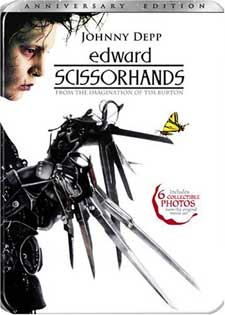
Ideology in Edward Scissorhands


Ann Devine, author of the essay entitled Edward Scissorhands, talks about not only ideology, but also America's culture. She talks a lot about our stereotypes and how the way people treated Edward changes throughout the movie.
Edward is initially treated very kindly (particularly by women) and described in terms such as 'different, mysterious, exceptional'... Suddenly, the very things which rendered him unique (scissorhands) are seen as evidence that he is a
dangerous criminal and unfit to live in 'normal society'.
Devine also brings up the stereotypes in women and men and what their roles in life are. The essay also talks about ideology in the fact that it brigs up racist and prejudice actions taken by the people in Edward's community. Basically, the essay talks about feminist, race, and class studies, which are all mentioned in Corrigan. It's a really interesting article to read so I suggest everyone reads it :)

Film As Religion

John C. Lyden, an author, makes an approach to religion, morals, and myth in his book, Film as Religion. He discusses in the book about specific views in an ideological way in film, primarily the topic of religion. The link is attached to the book. In the first few pages, the article/book discusses the overview of film, religion, and how it will be discussed within the chapters.


Most of the approaches can be understood as falling into one of two categories (or a combination of both thereof) that I would define as"theological or ideological".

Crash and it's ideology

The article "Crash" is written by Robert Jensen, a professor at the University of Texas, and Robert Wositzer, a film associate producer of the forthcoming documentary on pornography "The Price of Pleasure." They claims that the film "Crash" ideology revolvse around the notion of White supremacy. This article appeared online at Znet.com, which is a website about daily commentaries. Both Jensen and Wositizer agreed that the film is good and it's not a racist film. "Crash is white supremacist because it minimizes the reality of white supremacy. Its faux humanism and simplistic message of tolerance directs attention away from a white-supremacist system and undermines white accountability for the maintenance of that system." Jensen and Wositzer is reffering to the way the film puts all the violence towards minorities, and the good; as the white people are neglected and get the easy way out of guilt and fraud. Throughout the movie the whites gets hurt the least and is positioned in the most comfortable situations during the whole film.

Nazi Propoganda Films


I have linked to an essay titled Propoganda or Romance? Unfortunately the name of the author who wrote this short ideological criticism of Nazi films was not given. However, the article says brought to you by TermPaperEdge.com. The author tells about the basic goal of many Nazi films such as, La Habanera and Madeleine in Romance in a Minor Key and The Golden City. The goal of the German filmakers was to give the films audience an the illusion of a desirable situation like love or romance being attainable while the films background stays strongly committed to the Nazi ways. Many consider these films to be the best films Germany has ever made.

The Ideology of Harry Potter: Fascism vs. Liberalism


David Baake's article, The Ideology of Harry Potter: Fascism vs. Liberalism, appears on the website http://www.zmag.org/. This article primarily discusses the ideological meanings that lie beneath the magical surface of the famous Harry Potter series. This article covers both the books and the films. The author's main point is that the Harry Potter films ultimately represent certain aspects of World War Two. Baake states that :

"Significant parallels can be draw between the battle between Harry Potter and Voldemort and the battle between the Allies and Nazi Germany in World War Two...Lord Voldemort is unabashedly modeled after Hitler, and his Death Eaters are typical fascist paramilitaries. "

What is interesting with Harry Potter is that one can watch the films a million times and overlook the hidden messages. Baake supports his argument by quoting J.K Rowling, the author of the series, in describing the similarites between Lord Voldemort and Hitler. For more information about this, click on the link. Enjoy!

Saturday, March 3, 2007

Ideological Criticism

The above link is a book "Screening the Sacred: Religion, Myth, and Ideology in Popular American Film. The book was written by Joel W. Martin and Conrad Eugene Ostwalt. The third section is my focus, which is located on pages 119-125. The section is titled Ideological Criticism. Joel W. Martin is a professor of religious studies, Franklin and Marshall and has many published works; Conrad Eugene Ostwalt is a well-established author. This section of the book attempts to explain ideology. The author clarifies the original ideas of ideology, where it was rooted and how we use now. This is a great excerpt to help understand the ideology of film in America.

Ideological Analysis on Hotel Rwanda

The article Peasant Ideology and Genocide in Rwanda Under Habyarimana , was written by Phillip Verwimp who is an Economics professor at Yale University. This article appeared in Center for Economics Study and focuses on the developmental processes that took place in Rwanda before the Genocide and the neglect that soon came later after the horrible massacre. In this article Verwimp discusses the economy of Rwanda after the genocide. Verwimp stated,
Some societies have, in the past, opposed manual and intellectual labor with the latter giving in general more prestige to its performer. Such a concept not only seems outdated but also unacceptable because it is not realistic. In fact, manual labor, especially agricultural labor is the basis of our economy. We want to repeat that agriculture will stay the essential base of our economic system for years to come.

Ideology in Mississippi Burning


The article that I found was written by Alan Smithee. This name is a pseudonym used by Hollywood directors from 1968 to 1999 in order to write about films which had seen their creative control of the film wrested from them. The author felt that in this movie brought to the attention of the audience the ideological beliefs and following of the people in the "KKK" during the 1960's.
"Mississippi Burning brings out precisely the imperviousness of a Southern community to change - the intractability of economic and social oppression. At a time when the anti-liberal values of small town America still seem in the ascendant, and when the Supreme Court is whittling away at the achievements of the 1960's, the films underlying message is that all those battles have to be fought again and much harder than before."
During the film, the popular beliefs held by the men who killed the activists. It also brings to attention the beliefs of the two "G-men", played by William Dafoe and Gene Hackman. The head to head competition of the ideological beliefs of the two sides in the conflict represents the "political" views of the many people involved in the battle in the small town.

Friday, March 2, 2007

Ideological Analysis on Transamerica

"Transamerica" the title of the ideological essay that analyzes the film Transamerica, which was published on the site Salon.com. This particular site contains articles and essays that not only critique and discuss films, but comics, arts and entertainment, news and politics, books, community, life, sports, technology and business, online letters to the editor, and an opinion blog for readers to discuss with one another the various topics addressed on this site. Stephanie Zacharek, the author of the essay "Transamerica," is a well-known American film and music critic, whom writes frequently for Salon.com and Rottentomatoes.com.
The argument that Stephanie Zacharek is trying to make about the film Transamerica is that transsexuality is not a normal behavior that one should engage in; therefore, disagreeing with the film's belief that transsexuality should be more accepted by our culture, and not seen as abnormal. This particular film expresses the opinion that transsexuals should not be considered bizarre and are people like you and me.

Stephanie Zacharek states in her article "Transamerica," feels like a lesson in tolerance, pleading for us to recognize that transsexuals are just like you and me, even as it can't resist reminding us that they're not.

This essay is a great example of an ideological essay because of its stated argument on the film's take on how our culture views gender issues.