Showing posts with label Zhang Yimou. Show all posts

Monday, April 23, 2007

Yimou's Drive for "Not One Less"


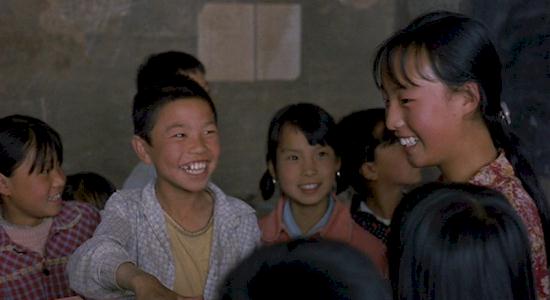
Paul Chen comments on Zhang Yimou's documentary, Not One Less. Tackling the high drop-out rate in rural China as its subject, Chen believes the film seems to endorse the state-sponsored Hope Project, which aims to raise money to place drop-out rural children back in school. Set in contemporary northern China, this film tells the story of a thirteen-year-old rural substitute teacher, Wei Minzhi, stubbornly trying to keep her twenty-eight students in school. In an attempt to retrieve one boy, Zhang Huike, whose family debt forces him to quit school and seek work in a nearby city, Wei finds herself in the strange and indifferently sophisticated city crowd. Chen states that the assumption of the film's confusion is justified by Zhang use of "documentary aesthetics."
"(Zhang's documentary involves) placing the camera on the street," location shooting in this film purports to deliver a slice of life, and more specifically, to elicit and capture the amateur actors' spontaneous (re)actions in real-life settings."

Chen futhur goes into how Yimou is effectively able to convert the rural village into a spectacle.

Contemplating Hero. Wuxia or worse?

Zhang Yimou’s Hero and the Globalization of Propaganda by Mark Harrison was published online for a website called "Wordpress". In the article he compares Hero to and earlier Wuxia film Crouching Tiger Hidden Dragon but immediately points out that there is a lack of propaganda in the film. He says that Hero almost merges Chinese cinema with Hollywood cinema using all sorts of creative effects to propagandize the story in the film.

Contrasting with the muted, earthy colours of Crouching Tiger Hidden Dragon,
Hero’s imagery does indeed a deliver a stunning looking film, wholly
unrestrained in its use of saturated colour and dramatic visual forms in ways
which few films have had the audacity to attempt. Its fight sequences are
spectacularly choreographed and staged, wielding colour, form and movement with
virtuosic skill. The cast, too, is beautiful, and A-list Chinese - Zhang Ziyi,
Tony Leung, Maggie Cheung and Jet Li.
At the same time, the film has no real
plot and no character development and its dialogue is made up of declarations of
fortune-cookie clichés. This points to empty spectacle, to a Chinese version of
the worst excesses of high-concept Hollywood cinema. However, Hero is far more
than an empty exercise in visual technology and marketing.

Is Hero Offensive?


Film Quarterly's critical article of Hero posted June 28, 2005 delivers applause towards the beautifully artistic martial-arts scenes, as well as questions the films intent. According to the article, the film's political stand justifies despotism, tyrannical rule, in China's history. "Viewers may leave with the impression that the film's message is simply that abandoning the attempt to kill the King of Qin was the right thing to do, for the sake of bringing an end to the chaos in China; and that, for his feat of unifying China, the first emperor deserves to be regarded as a hero." The article continues that in actual historical accounts of the first emperor, he is regarded as a tyrant. By assigning the emperor hero-like qualities conflicts arise, since the film portrays a "favorable attitude towards tyranny." In addition, the article questions, "Despite his success in unifying China, should the first emperor not be held accountable for his brutality?"

Hero Yhang Zimou

This offers a brief summary of the movie going through all tghe important point and then moves into a more analytical mode to find the true meaning of Hero which is ambiguous and highly debatable.


Sunday, April 22, 2007

Hero

In the movie review, Kenneth Turan claims that Hero is "the most artistically sophisticated, most formally beautiful martial arts film the genre has seen." The film is based on Chinese history involving the king of Qin, the third century BC ruler who united other six kingdoms and became the emperore of China. Turan writes that the color schemes in the movie was very impressive. The movie review qoutes, " Great emphasis is laid on intertwined cultural and moral issues: the parallels between martial arts and music, the way fighting skill can be rooted in calligraphy, even the possibility of pacifism within a martial world."

Saturday, April 21, 2007

Chinese Cinema and Zhang Yimou


This article by Eleanor Hisaye Taniguchi talks about Chinese cinema, namely, Zhang Yimou's movies. Believed to be the best "fifth generation" director, Yimou movies, such as 1984's Yellow Earth and the 1987 film Red Sorghum, were huge successes in Chinese. This was not the case, Taniguchi states, for those movies banned in China and Hong Kong.

Taniguchi talks in great detail about Zhang's global-breakthrough movie, Hero.
"Zhang's true redemption in the eyes of the Chinese government however, came with the release of Hero in 2002."
The article continues to talk about how the movie was the most successful Chinese film gross around $100 million in China, America, and Hong Kong combined.

Taniguchi later touches on the color coordinated scenes, "characters float through color themed sets,... pursue one another over trees bathed with autumn gold, ride through yellow deserts with blue mountains in the background."

Many of the questions we raised in class about Hero were touched in this article.
Taniguchi believes Zhang portrayed Snow as a "unruly, destructive" female protagonist in the film, thus this film implies women are wrong, and men know better.

Also, Taniguchi thought Hero intoned that centralized government is good, which puzzled her since
"The Emperor Qin, known to every Chinese schoolchild as being a brutal tyrant who unified China"
was portrayed as a wise, somewhat emphatic ruler, with a "grand vision" for China.

Dissection of Hero

This article dissects the movie into 5 parts. One part is 5 minutes in where Pruyune disscusses the black and white strategy that Zhang Yimou uses in the fight scene that takes place in the mind. Pruyne also shows the affects this scene has on the entire story. The next breakpoint is the colorful scene where Moon fights Snow. Pruyne says that this scene reiterates the theme of evolution. The next breakpoint is when the King questions Nameless about his story. The nest two breakpoints take place at the end of the movie.

Dissection of the Structure of Hero

This article dissects the movie into 5 parts. One part is 5 minutes in where Pruyune disscusses the black and white strategy that Zhang Yimou uses in the fight scene that takes place in the mind. Pruyne also shows the affects this scene has on the entire story. The next breakpoint is the colorful scene where Moon fights Snow. Pruyne says that this scene reiterates the theme of evolution. The next breakpoint is when the King questions Nameless about his story. The nest two breakpoints take place at the end of the movie.

Zhang Yimou on "HERO"


In the article that I found by Lisa Bear,written for indiewire.com, many different elements of the film Hero were addressed. While the article starts with a synopsis of the film, it branches out into a brief formalist look at the film, comparing both shots that were used and sounds featured in the film.

Memorable for its finely-judged performances, superlative sound design and stylized visual compositions, shot by renowned Australian cinematographer Chris Doyle, this is a martial arts film that contrasts orderly military formations in wide shot with lyrical close-ups. A volley of arrows fills the skies like a swarm of bees or plague of locusts rather than the tools of warfare. Lingering shots of gleaming metal, the sonorous hiss clang and echo of a sword being unsheathed or falling to the ground evoke harmonics and reverb rather than unsightly atrocities--torn limbs and membranes or screams of pain.


The article then goes on to recount an interview that Lisa Bear had conducted of Zhang Yimou. In the interview transcript, Yimou answers questions about the film, China, and some of the color schemes in the film.

IW: How did you come up with the color changes in the film: red, white, blue and green?

ZY: "Hero" is not a traditional martial arts movie. It's very structurally presented. I like Rashomon, and thought I could use different colors to represent different parts in the movie.

IW: Why those particular colors, red, white and blue?

ZY: There's no particular meaning to each color. I just needed the colors to represent...

IW: Points of view.

ZY: Yes, yes. Each color represents a different period and different [way of telling the] story...


Overall, it is a well written article which contains many different view on the film Hero. It gives the reader an insight into the mind of Zhang Yimou and how he wanted to make the film appeal to the audience.

Thursday, April 19, 2007

Zhang Yimou "Hero"

This article, 'Hero': Easy on the eyes but a little too plodding written by Mike Clark focuses on the movie Hero. In this article the writer discusses the characters in the movie and how the movie was the most successful foreign film and also how it made a big hit in the United States.

Ying xiong (2002)

This is a review with some critical elements by Mark R. Leeper at OptOnline.net. Hero turns out to be one of the most expensive films made in China as china tries to expand its influence worldwide. The author talks about the use of colors in the movie, which are dull sometimes and sometimes very contrasting with the actors wearing bright clothes compared to the surrounding. We can see that in the scene when Moon fights with Snow (both wearing red) in a yellowish green set (the color of the leaves). The following quote very much sums up the plot 0f the movie:


"HERO combines the fantasized martial arts of CROUCHING TIGER, HIDDEN

DRAGON with some of the same history from the under-rated THE EMPEROR

AND THE ASSASSIN. It has neither the rousing adventure of CROUCHING

TIGER nor the historical epic sweep of THE EMPEROR AND THE ASSASSIN.

But the visual style of production designers Huo Ting Xiao and Yi Zhen

Zhou and cinematographer Christopher Doyle makes this one of the most

beautiful films that has been seen on American screens in quite a while."


One thing that was also noticed in the film is the lack of blood which the author believes is due to sensitivity of the audience in China. It is somewhat unrealistic that just a few drops of blood are seen when the fighting sequences are very intense. I believe one more thing that is missing in the film is fire. In the hollywood, we see that fire does play a role either through guns / bombs in action movies or flying arrows / burning villages in historical villages. I was surprised that the Qin soldiers weren't shown burning the villages of their enemies or using arrows of fire, like in Kingdom of Heaven, when China supposedly invented gun powder.

Tuesday, April 17, 2007

3 Years Later "Hero" Makes It To the U.S.


Jeff Vice, from Deseret Morning News, talks about the release of Hero in the U.S. in his article: 'Hero' finally opening in U.S. after being held for 3 years. He mentions that Hero was originally released in 2001 under the name "Ying xiong" and was nominated for Best Foreign Feature by the Academy Awards. This marks the first martial arts film for director Zhang Yimou .Vice quotes Yimou saying "I am not a martial-arts filmmaker. So I had to convince people to take a chance on me and on the movie." Vice explains how "'Hero' has some things in common with 'Crouching Tiger.'" The both the fight choreographer, Yuen Wo-ping, and the soundtrack composer, Tan Dun, on worked on these two films. He also talks about the challenges Yimou faced when directing his first martial arts film. He admitted that "To make an action film was quite a challenge for [him]." He even got help from Quentin Tarantino.

Chinese Cinema: Hero

This critical article was written by Eleanor Hisaye Taniguchi. It discuses the globalization of Chinese cinema, and it focuses on Zhang Yimou's movie Hero. It gives a background on Zhang Yimous life and the work he has done in the past. It also talks about the Chinese governments outlook on these films and how things are changing.

Chinese Cinema: Hero

This critical article was written by Eleanor Hisaye Taniguchi. It discuses the globalization of Chinese cinema, and it focuses on Zhang Yimou's movie Hero. It gives a background on Zhang Yimous life and the work he has done in the past. It also talks about the Chinese governments outlook on these films and how things are changing.

Zhang Yimou's Movies Get a Thumbs Down

This critical article written by Adam Graham-Silverman is entitled Why Zhang Yimou's Two Movies Shouldn't be on Top-Ten Lists: Critical Mistake. In the article, Silverman talks about two movies both directed by Zhang Yimou: Hero and House of Flying Daggers. Silverman talks about how although these two movies may be unique with their color choices and special effects, that doesn't make them good movies. Silverman goes on to say,
Critics should not mistake unique for good. Many critics are indeed snared by the surface elements of Zhang's two films: the wire-work fight scenes and the luscious use of color. But even if one examines only these formal structures, the movies still don't have much to offer.
Silverman goes on to talk about Hero by saying,
In the best classic wuxia films, the formal elements skillfully take on the functions that plot and dialogue often serve. While Zhang also focuses on these aspects, he doesn't achieve that synthesis. Like his color work, the movies look pretty but ultimately feel meaningless.
Silverman criticizes the slow-motion used in Hero by saying how it takes away from the few scenes that are interesting and making them all about the special effects instead of the plot.
Very quickly the overload becomes desensitizing and we're left feeling bored.
All in all, Silverman doesn't seem to like these two movies directed by Yimou. Not only does he criticize the overuse of special effects, but he thinks American critics are too nice towards the movies.

"Fifth to Sixth"

In this interview by Tan Ye with Zhang Yimou who explains the reasoning for the use of the color "Red" in most of his films: "Red Sorghum, Red Silk, Red Lantern, Red Dress, and so on."

This article goes more in depth to explain why some of Yimou's are still banned in China, I advise reading this article to find out more. This interview adresses many important issue regarding ALL OF HIS OTHER FILMS. Tan Yen asks Zhang what is the difference between his Fifth Generation production of film compared to the new Sixth Generation, now? This Interview by Tan Ye answer most of the questions we have not gotten answered.

Monday, April 16, 2007

Profile of Zhang Yimou


According to publishing company Baseline, notable Chinese director Zhang Yimou significance in the film world is his development of highly artistic films that are globally successful. Also the ideology expressed by his extensive use of actress Gong Li as a main character in almost all of his films captures "...tension between the graceful surface of cultural tradition and the turbulence of youth and injustice towards women which all his films explore." The talent of this director artistically and commercially has raised so much attention that "The Chinese central government has also conscripted him to craft national propaganda: he directed videos for Beijing's Olympic bid and Shanghai's successful application to host the 2010 World Expo," which may produce the most global popularity yet.

Zhang Yimou, Curse Of the Golden Flower

The article im linking to today stars off by comparing this film to some of his prior films and letting the reader know that this film will not disappoint. There is a brief plot summary in order to get the reader up to speed on the movie then there is an ideological and formalist analysis

Zhang Yimou

This article is on director Zhang Yimou and his film career. You can find a lot of information on his life and other films that he has made. They also give details about his films and how he is a unique director with his own style. He uses his heritage to create his films and is has become a very well known director in his country and around the world. His films are known for having great action and the he does a good job of using bright colors in the scenes. His films are loved because of his creativity and love for his culture.

Sunday, April 15, 2007

Everything You Have Ever Wanted to Know About Zhang Yimou


The link provided goes in-depth on Zhang Yimou's life as a director. It starts off by talking about his earlier career when he was just starting off in the movie business and how he got to where he is today. It also writes about each movie he helped create and gives a brief summary of each. An interesting fact about Hero was also mentioned:
Hero became one of the few foreign-language films to debut at #1 at the U.S. box office, and was one of the nominees for Best Foreign Language Film at the 2003 Academy Awards.
If you ever wanted to know anything about Zhang Yimou, this is where you will find it.