Showing posts with label jimmy schafer. Show all posts

Friday, May 4, 2007

The Quentin Tarantino Effect

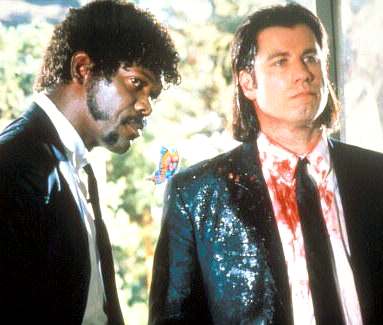
Samuel Jackson and John Travolta in Pulp Fiction

In this article by Stanley Crouch, Quentin Tarantino is viewed as the leading young filmmakers of his time. Tarantino's movies, such as Natural Born Killers, Pulp Fiction, Reservoir Dogs, True Romance, and Jackie Brown, hard-edged, ultra violence with shots of absurd and unexpected humor. Crouch sees Quentin as adding new energy, cool, comedy, and irony, to a low age in movies.

Some of Quentin's use of irony is discussed my Crouch, who sees Quentin discussing our ethnic identity through many of his movies. Examples are given from Pulp Ficton, Jackie Brown, and Reservoir Dogs. Crouch notices that in Reservoir Dogs, blacks are referred as inferiors by the Caucasian cast, but they talk about how attractive Pam Grier (a famous black actor) is. This ironic racism Tarantino adds continues when the undercover cop's mentor turns out to be a black man.
Those alterations reach far beyond the customary racial cliches that thud upon us frame by frame and the hostile or maudlin soap box oratory that washes all possible eloquence out of dialogue.

Crouch finishes by stating Quentin's film making is recognizable yet unfamiliar: "we feel we've seen it and not seen it before."

Monday, April 23, 2007

Yimou's Drive for "Not One Less"


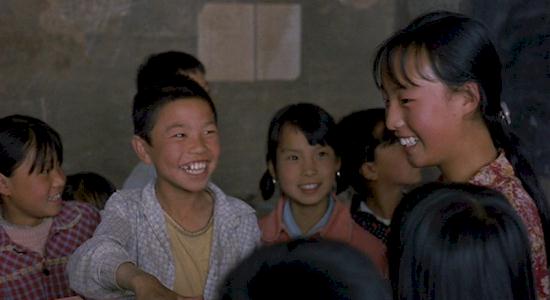
Paul Chen comments on Zhang Yimou's documentary, Not One Less. Tackling the high drop-out rate in rural China as its subject, Chen believes the film seems to endorse the state-sponsored Hope Project, which aims to raise money to place drop-out rural children back in school. Set in contemporary northern China, this film tells the story of a thirteen-year-old rural substitute teacher, Wei Minzhi, stubbornly trying to keep her twenty-eight students in school. In an attempt to retrieve one boy, Zhang Huike, whose family debt forces him to quit school and seek work in a nearby city, Wei finds herself in the strange and indifferently sophisticated city crowd. Chen states that the assumption of the film's confusion is justified by Zhang use of "documentary aesthetics."
"(Zhang's documentary involves) placing the camera on the street," location shooting in this film purports to deliver a slice of life, and more specifically, to elicit and capture the amateur actors' spontaneous (re)actions in real-life settings."

Chen futhur goes into how Yimou is effectively able to convert the rural village into a spectacle.

Saturday, April 21, 2007

Chinese Cinema and Zhang Yimou


This article by Eleanor Hisaye Taniguchi talks about Chinese cinema, namely, Zhang Yimou's movies. Believed to be the best "fifth generation" director, Yimou movies, such as 1984's Yellow Earth and the 1987 film Red Sorghum, were huge successes in Chinese. This was not the case, Taniguchi states, for those movies banned in China and Hong Kong.

Taniguchi talks in great detail about Zhang's global-breakthrough movie, Hero.
"Zhang's true redemption in the eyes of the Chinese government however, came with the release of Hero in 2002."
The article continues to talk about how the movie was the most successful Chinese film gross around $100 million in China, America, and Hong Kong combined.

Taniguchi later touches on the color coordinated scenes, "characters float through color themed sets,... pursue one another over trees bathed with autumn gold, ride through yellow deserts with blue mountains in the background."

Many of the questions we raised in class about Hero were touched in this article.
Taniguchi believes Zhang portrayed Snow as a "unruly, destructive" female protagonist in the film, thus this film implies women are wrong, and men know better.

Also, Taniguchi thought Hero intoned that centralized government is good, which puzzled her since
"The Emperor Qin, known to every Chinese schoolchild as being a brutal tyrant who unified China"
was portrayed as a wise, somewhat emphatic ruler, with a "grand vision" for China.

Tuesday, March 20, 2007

Gulf War Effect


The article by Melissa Krupa speaks about the immediate effects of the First Persian Gulf War on various Middle Eastern Countries, especially Kuwait and Iraq. The effects Krupa speaks of are in regard to the economic shifts and environmental destruction.

Like the hundreds of thousands humans killed or wounded during the Gulf War, the environment was hugely effected. Solid waste pollution, and air pollution contaminated the soil and polluted the waters. Oil related issues damaged the environment the most.
As promised, upon evacuation, Iraqi troops set fire to over six-hundred oil wells in several Kuwait oil fields. The effect that the oil fires had on the Gulf environment were enormous.
Krupa also estimates that 11 million barrels of oil were dumped into the Arabian Gulf, twenty times more than the famous Exxon Valdez Spill. The price to clean up the oil spills is estimated at $700 million.

Oil was also the driving force for economic issues. Krupa states that the Gulf War started due Kuwait overproducing oil, driving the prices down. At the moment, Iraq was still repaying debt, and were greatly effected by the decrease in oil prices. Saddam's frustration and start of the Gulf War led to a bigger debt for Iraq, an estimated $50 billion in military equipment alone.

Frank Darabont


This article by D.K. Holt has a list of director/writer Frank Darabont's movies he directed/wrote. The two most well-known movies are "Shawshank Redemption" and "The Green Mile".

Holt compares and contrast's Darabont's directing for "Shawshank Redemption" and "The Green Mile". He points out that Darabont likes to cast tall people, such as Tim Robbins and Michael Duncan, for his starring roles. Holt also states that Darabont is not a great director/writer, but he
"knows his limitations and mines cunningly his thin if abudent vein of his talent".

Later in the article, Holt writes about Darabont's connection with Stephen King, who's books were the basis of Darabont's blockbuster movies.
(Stephen) King's world is that of the '50s, and Darabont embraces it ultimately to his detriment. King is an American child of the Eisenhower era obsessed with bullies, with social approval, with high school hierarcies, with the pop culture that kids from the '50s experienced. As the victim of bullies, he also drifted toward respite in an easy liberalism that is manifested in The Green Mile as a portrayal of a black man as a simple soul with a noble spirit that shows dignity under oppression, a creature singled out by God for a special gift.

Wednesday, March 7, 2007

Prison in Film History

(Top picture is from The Big House (1930). The bottom picture is from Shawshank Redemption (1999).)
This article briefly describes David Gothier Jr.'s book, "American Prison Film Since 1930: From The Big House to The Shawshank Redemption". The book gives a historical analysis on well known prison films. Gothier believes that prison films have their own separate genre, which has been falsely compared to western, horror, and gangster films.
The article goes on to say that
"the prison movie is perhaps the only pure-bred genre that yields so many other genres within its original framework: gangster prison films (The Big House), film noir prison films (Brute Force), western prison films (There Was a Crooked Man), sports prison films (The Longest Yard), science fiction prison films (Escape from New York), the POW film (Stalag 17), even musicals (Chicago)."

The base of the book deconstructs in great detail twelve films, including Shawshank Redemption, based on the rules of the prison genre.

Monday, February 5, 2007

The Big Elephant in the Room


How many of you have done a 17 hour shift at work? In China Blue, directed by Micha Peled, hundreds of Chinese children work that shift every day.

Attached is a article by Beverly Berning, who explains how China Blue gives a personal face to what we only knew as a concept, child labor in sweatshops. Beverly later describes how Peled draws the problem of sweatshop labor on not the sweatshop laborer, but the multinational corporations (in this case, Wal-Mart), cold-shouldered American inspectors, and us, the consumers. Peled makes the viewer recognize this truth by avoiding the "sad sermon", and says just enough for us to recognize this national epidemic.
"It would be enough if China Blue simply worked as an exposé of the harsh lives these young girls live, but director Peled is too much of a leftwing activist to leave it at that. He has bigger fish to fry, namely the multinational retailers who set the agenda, the ones who pressure men like Lam (who comes off here less as a villain than an arriviste) to sell their blue jeans at ridiculously low prices. "
"Globalization is here to stay, and it presents us with yet another set of problems that we must address. China Blue does not offer solutions, but it might help get us to stop ignoring the problems. It is the little elephant that roared."

Tuesday, January 30, 2007

Letters from Iwo Jima: Nationalism and Corruption


Wither Letters from Iwo Jima is a historically-correct Japanese film or not, Clint Eastwood's themes is still clearly seen.

Attached is a link to Roger Ebert's film article, which touches the themes of Nationalism and Corruption. Ebert writes about how Letters from Iwo Jima is like it's brother film, Flags of Our Fathers, but instead in the Japanese perspective. He points out that not only was pride for the country was strong on both American and Japanese sides, but the propaganda in each nation as well.

"This is the hole that we will fight and die in." (Nationalism)
"The Imperial Headquarters is deceiving not just the people but us as well." (Corruption)

Tuesday, January 23, 2007

Perfume: The Story of a Murderer


Although this movie is still in theaters, Perfume: The Story of a Murderer is a good candidate for the final project. It will probably come out on DVD too late to use it for the final, but it is still a good film to watch, especially on the big screen.

Jean-Baptiste Grenouille was born with the most phenomenal sense of smell. He was born in the wrong time though, because 18th century France had a putrid smell to it. Jean-Baptiste nose leads him to become one of the greatest perfumers in France, but that is not enough for his greedy nose. He takes a dark turn as he tries to preserve "beautiful" scents, and create the ultimate perfume.

Perfume seemed to have somewhat a comical idea (super-nose powers), but the movie is so much more. Go to the theaters and watch this movie!

The link attached is the official trailer.

Monday, January 22, 2007

Badlands by Terrence Malick


"He was 25 years old. He combed his hair like James Dean. She was 15. She took music lessons and could twirl a baton. For a while they lived together in a tree house. In 1959, she watched while he killed a lot of people."

Loosely based on the Starkweather-Fugate killing spree during 1958, Badlands is a film about a "innocent" teenage girl, Holly, and her older boyfriend, Kit. Holly's father strongly forbids their relationship, so Kit kills him. This event began their killing spree adventure to the Badlands of Montana.

The link attached is a trailer of this 1973 Thriller/Drama/Romance.