This article supplies information for people to have a better understanding of why the veterans of the Persian Gulf War might have had illnesses post-war. There have been many syndromes that have been associated with these veterans with symptoms including fatigue, headaches, forgetfulness, etc... The illnesses included serious psychiatric conditions dealing with post-traumatic stress disorder and acute combat stress reaction. This article mentions how there was not one specific disease that the veterans had, but that a good number of them were mentally damaged after experiencing the war. The research has many limiations, but "until we can better understand what constitutes health and illness in all adult populations, we risk repeated occurrences of unexplained symptoms among veterans after each war".
Showing posts with label Gulf War. Show all posts
Showing posts with label Gulf War. Show all posts
Monday, April 9, 2007

Three Kings: An anti-war movie
This is a link to a critical article describing the intention of the David O. Russell in his production Three Kings. The author of the article, David Edelstein, a film critic for Slate.com, states that Russell had interviewed veterans from the first Gulf War. The veterans states that they were sickened as they encouraged Iraqi insurgents to rise-up against Sadaam Hussein and could not intervene when getting slaughtered by him. Edelstein points out that the torture's purpose is to demonstrate, "for the naive American what the Iraqi says is the war's real aim -- protecting oil reserves -- by pouring a ladle of crude down Barlow's throat." The author moves on to say that Russell is doesn't see much of a difference between the Iraqi soldiers and the American soldiers by showing the Iraqis with American products. The article gives more examples to show that Three Kings is an anti-war film.

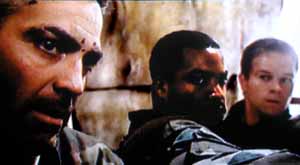
This picture is a shot after George Clooney's character saved Troy (Mark Wahlberg) from torture.

This picture is a shot after George Clooney's character saved Troy (Mark Wahlberg) from torture.
Sunday, April 8, 2007
Three Kings: Truth behind the war?

In the article by Andrew O'heir, the author starts to explain the movies true meaning. He begins though by saying,
"Three Kings" is one of the most exciting Hollywood action films in years, and the best Vietnam movie since "Apocalypse Now."O'heir goes on to explain how Three Kings serves as a perfect example to someone trying to understand the true meaning of the Gulf War or American Military history in general. The author explains how all of this conflict that has risen was all brought along by Vietnam. The article also talks about the unique shots the director chose to take. For example, O'heir explains the scene where we, the audience, are taken through the body of a soldier to see a bullet wound.
The War in Three Kings
This is a link to a critical article discussing the Gulf War and how it was depicted in Three Kings. It was published in the Montreal Film Journal but I wasn't able to locate the authors name.
According to the author, the Gulf War was depicted in the same way the Vietnam War was depicted in the Climino. However, he feels this film was very successful in revealing what really went on at the time of the Gulf War. While doing so, the author manages to discuss ideology, nationalism and formalism.
Here is a quote
Three Kings" is a movie in a league of its own. Before you can see similarities with another film, it takes you somewhere else unexpected. There's some smart-ass humor, action scenes as exciting as any non-"Matrix" film you saw this year,politics... Russell (best known for indie gems like "Spanking the Monkey" and "Flirting with Disaster") gives it all a stylish look, with a camera that barely ever stops moving to keep us right where the action is
Tuesday, April 3, 2007
Iraq: Post Gulf War
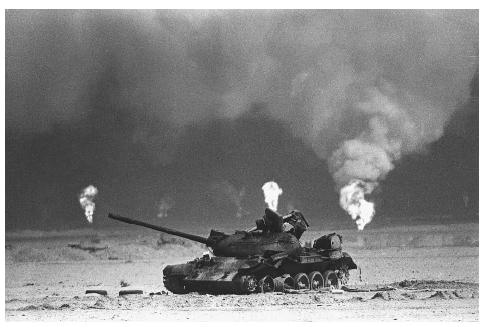
The Gulf War ended officially on 28 February 1991. It was known to the American military as "Operation Desert Storm." One of the largest controversies surrounding the end of the war, and is even touched on in David Russel's Three Kings, was the call by The United States of America to rebel against Saddam. They promised military help and support if they were to start a coup. However, when those disenfranchised citizens did rise up against Saddam both in the North and South, the US did not aid them and they were brutally and quickly defeated.
This betrayal of word cost many Iraqi lives and trust. In the current war against Iraq, many citizens are wary of The United State's commitment and motives.
Three Kings: neocolonial Arab representation

 Lila Kitaeff gives an ideological review of contemporary media through the film Three Kings. The article begins by exploring the current events leading up to the war. Kitaeff gives facts about "Arabs" and President Bush. The first section that focuses on Three Kings directly is the part entitled "The Gulf War on film". This section begins "Three Kings (Dir. David O. Russell, 1999) is a complex film exploring the ramifications of the 1991 Persian Gulf War." Following this is a basic movie overview which leads to the next section, "Non-oppositional critique of Gulf War." These upcoming paragraphs will show a sorting of the main character's individual film history.


Monday, April 2, 2007
What might have happened and what did happen after the Gulf War

On August 2, 1990, Iraqi Republican Guard invaded Kuwait and took control of that country. The United States responsed to prevent any invasion of Kuwait's neighbor Saudi Arabia; this was called Operation Desert Shield. After Saddam Hussein did not remove his forces by the deadline Bush gave Saddam did we attack Saddam's army and drove them out of Kuwait; this was called Operation Desert Storm. It only lasted 100 hours before we pushed them all out and then calling off the ground war. "almost all Americans seems to believe the U.S. military should have pushed on beyond the terms of the mandate that President George Bush had requested from the U.N. and conquered all of Iraq." This article written by Steve Sailer explains what might have happened if we went and invaded Iraq. Steve also explains what happened Immediately after the war within Iraq.
Sunday, April 1, 2007
Persian Gulf War
The link is to an article from Encyclopedia Britannica. It is an overview of the first Gulf War. Iraq invaded Kuwait on August 2, 1990 with a goal to secure Kuwaiti oil reserves at the same time expanding Iraq. "Iraq's invasion and the potential threat it then posed to Saudi Arabia, the world's largest oil producer and exporter, prompted the United States and its western European NATO allies to rush troops to Saudi Arabia to deter a possible attack." Before the war started there was a massive buildup of military forces known as Operation Desert Shield. The actual war started on January 16/17 1991 with a massive air attack with the United States leading the way. The air attack became known as Operation Desert Storm destroying most or all of Iraqi defenses followed by an allied ground attack Operation Desert Sabre. The whole war claimed 8000-100000 Iraqi lives, while the allied forces lost only about 300.
Sunday, March 25, 2007
Gulf War

In the movie, Three Kings, the Gulf War is showing with an American viewpoint. This war which was between Irag and a group of other countries including the United States was fought in order to liberate the country of Kuwait. The reason people wanted to see the film Three Kings when it came out was simple. It had been quite a while since the war had been other when the film came out. People are usually interested in films such as these. They want to relive some moments to a certain degree and see how it was back then. Things change other time and so do political views. One may wonder the true motives behind the whole war after watching such a film.
First Persian Gulf War in Three Kings
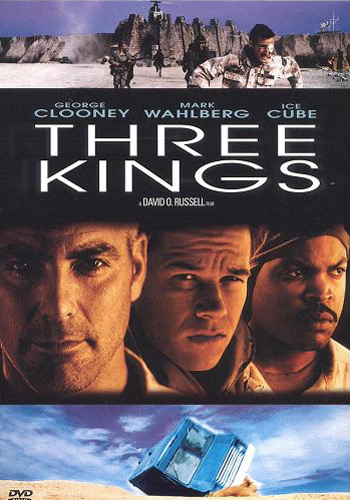 This is an excellent article written by Julie Lorenzen. She talks about how the Persian Gulf War was used as the bigger story in the movie, The Three Kings. She goes on to explain about the events that were happening in America at the time that the movie was released (1999).
Hussein was still in charge of Iraq. There were complaints from American soldiers in the Gulf War were suffering from the side effects of the gases supposedly used by the Iraq army. The filmmakers might have feared that if George W. Bush won the election, he’d try to finish his father’s business in Iraq. The film seemed to be a statement of why we shouldn't’t go back because it chronicled the suffering of the Iraqi people.Lorenzen goes on to explain the plot of the story, the emotional impact of the story, and the overall role that the American soldiers played in the movie and how the war effected them.
The filmmakers were sympathetic to the Iraqi people and critical of the Bush administration...In conclusion, The Three Kings stood out from the other films because it focused on U.S policy and military rather than on politicians and their staff.This is an excellent article to read in order to get an idea of what our major project should be like, so I suggest that everyone check this one out.
Effects of the Gulf War
In this article, General Charles Horner explains what we have learned from the Gulf War. He claims that the Gulf War showed the U.S. that they had to improve their bombing force to be able to be a force in the 21st century. The Gulf War showed how important the capability of long ranged attacks is crucial. Horner also goes on to explain other important issues that the U.S. has learned from the war including using stealth, being aware of a surprise attack, etc. The Gulf War proved to be an influential time during American History, which came immediately after the end of the Cold War.
Tuesday, March 20, 2007
Gulf War Effect

The article by Melissa Krupa speaks about the immediate effects of the First Persian Gulf War on various Middle Eastern Countries, especially Kuwait and Iraq. The effects Krupa speaks of are in regard to the economic shifts and environmental destruction.
Like the hundreds of thousands humans killed or wounded during the Gulf War, the environment was hugely effected. Solid waste pollution, and air pollution contaminated the soil and polluted the waters. Oil related issues damaged the environment the most.
As promised, upon evacuation, Iraqi troops set fire to over six-hundred oil wells in several Kuwait oil fields. The effect that the oil fires had on the Gulf environment were enormous.Krupa also estimates that 11 million barrels of oil were dumped into the Arabian Gulf, twenty times more than the famous Exxon Valdez Spill. The price to clean up the oil spills is estimated at $700 million.
Oil was also the driving force for economic issues. Krupa states that the Gulf War started due Kuwait overproducing oil, driving the prices down. At the moment, Iraq was still repaying debt, and were greatly effected by the decrease in oil prices. Saddam's frustration and start of the Gulf War led to a bigger debt for Iraq, an estimated $50 billion in military equipment alone.
Monday, March 19, 2007
The Deaths of Children

For most parents, the loss of a child would be their greatest tragedy. In Iraq, tragedies such as these increased immediately after the Gulf War according to a 1992 New England Journal of Medicine article titled Effect of the Gulf War on infant and child mortality in Iraq. According to the article, the increase of economic embargo's lead to the "malnutrition and morbidity among Iraqi children after the onset of the Persian Gulf war." Statistics outlined by "survey['s]of 271 clusters of 25 to 30 households" report "The age-adjusted relative mortality for the period after the war began, as compared with the period before the war, was 3.2 (95 percent confidence interval, 2.8 to 3.7)." These startling figures could provide additional causes to the increased turmoil in the region, as well as U.S.-Iraqi tensions. In conclusion the New England Journal of Medicine states "These results provide strong evidence that the Gulf war and trade sanctions caused a threefold increase in mortality among Iraqi children under five years of age. We estimate that more than 46,900 children died between January and August 1991."
Subscribe to:
Posts (Atom)