Showing posts with label critical review. Show all posts

Thursday, April 19, 2007

Ying xiong (2002)

This is a review with some critical elements by Mark R. Leeper at OptOnline.net. Hero turns out to be one of the most expensive films made in China as china tries to expand its influence worldwide. The author talks about the use of colors in the movie, which are dull sometimes and sometimes very contrasting with the actors wearing bright clothes compared to the surrounding. We can see that in the scene when Moon fights with Snow (both wearing red) in a yellowish green set (the color of the leaves). The following quote very much sums up the plot 0f the movie:


"HERO combines the fantasized martial arts of CROUCHING TIGER, HIDDEN

DRAGON with some of the same history from the under-rated THE EMPEROR

AND THE ASSASSIN. It has neither the rousing adventure of CROUCHING

TIGER nor the historical epic sweep of THE EMPEROR AND THE ASSASSIN.

But the visual style of production designers Huo Ting Xiao and Yi Zhen

Zhou and cinematographer Christopher Doyle makes this one of the most

beautiful films that has been seen on American screens in quite a while."


One thing that was also noticed in the film is the lack of blood which the author believes is due to sensitivity of the audience in China. It is somewhat unrealistic that just a few drops of blood are seen when the fighting sequences are very intense. I believe one more thing that is missing in the film is fire. In the hollywood, we see that fire does play a role either through guns / bombs in action movies or flying arrows / burning villages in historical villages. I was surprised that the Qin soldiers weren't shown burning the villages of their enemies or using arrows of fire, like in Kingdom of Heaven, when China supposedly invented gun powder.

Tuesday, April 3, 2007

Critical review of "Three Kings"

"Peace is hell if you go by "Three Kings," an untidy but nontheless significant muckrake of the Persian Gulf War." This is taken from the critical review written by Michael S. Goldberger. In the reiviw he goes on to give a short summary of the film and talks about different characteristics that director david O. Russell uses in the film. Check it out and enjoy!

Photo Sharing and Video Hosting at Photobucket

Monday, February 12, 2007

Pulp Fiction


The film initiates with two small-time thieves, Honey Bunny and Pumpkin, who spontaneously decide to hold up a restaurant. The film then shifts to the story of Jules and Vincent, who hit men for the well known and feared Marsellus Wallace, who is caught up in a deal gone wrong with struggling boxer Butch Coolidge.

The movie shows that tarantino is a genius. His idea of using narrative based action instead of things going in chronological order has since been copied by famous movies like Memento. But the biggest art of Tarantino is how he was able to let his character's evolve over the course of the film even though there were four different stories in the film, all connected to each other in different ways.

I think this quote best sums it up,
Back to the dialogue. It is the driving force of the film,

complementing the plot and allowing its characters to grow on us in

ways we never imagined they would. It's the way in which the dialogue

is deliberated that varies from most other examples of deliberation. ...

There are different levels of dialogue -- plot-driven, and realistic

-- but all dialogue is in service of its plot, just as all of what we

say to our friends or family has a deeper meaning and will no doubt

relate to the matter at hand. All dialogue relates to a larger scheme,

and so does the dialogue in "Pulp Fiction."


This is a link to the critical review:
http://us.imdb.com/Reviews/374/37494

Thursday, February 8, 2007

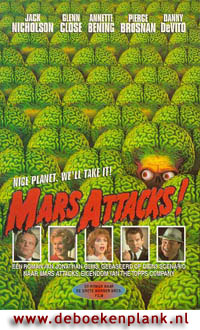
Mars Attacks!

Gary Johnson writes his article about the 1996 crazy, weird and goofy Martians who are trying to take over Earth. Johnson then goes on to explain the Martians,

"Instead of vicious tentacled monsters, we get big-headed, bug-eyed Martians with
ray guns that look exactly like souped-up water pistols."
Johnson explains how the movie was based off of a popular 1962 trading card game entitled Topps. He praises the movie and his only criticism was the fact that it opened around the same time that Independence Day so it was overlooked by many. Johnson considers this movie a gem and applauds Tim Burton for his creative twist on the classical Martians evade Earth plot. The provided link is from Corrigan's Images: Journal of film and popular culture, enjoy!

Casino Royale: Taking a Critical Look

Michael Noble, author of this critical essay starts off by giving a brief summary of the last Bond movie to be released in theaters (Die Another Day). He explains how this set up the newly released film Casino Royale and explains why Bond is so different in this movie. Noble also gives history/background of the previous Bond's portrayed by Sean Connery, Roger Moore, Timothy Dalton, and Pierce Brosnan in hopes of comparing the new Bond, Daniel Craig to the others. In his article, Noble gives Craig high praise for his refreshing role as Bond and to the movie for staying real to Ian Fleming's creation of Bond in his many books. Noble also applauds the more realistic characters and scenes in the movie by saying,
"More Jack Bauer than Austin Powers, Daniel Craig plays James Bond as a spy for our interesting times. With images of real torture beamed nightly into our living rooms, we are a long way from the elaborate castration-by-laser of Goldfinger."
Noble ends his article with a salute to the new James Bond. The link provided goes straight to flakmag, which is where I found the article. Below is the ending paragraph of Noble's article, which I found interesting.
"Bond ends Casino Royale by uttering his most iconic line: "The name's Bond, James Bond." It is fitting that he waits until the end to introduce himself. 007 has come full circle. Yes, the world has changed, but in a way that only makes Fleming's original conception of him more relevant. The real James Bond is back."

Tuesday, February 6, 2007

Criticizing Forrest Gump

The author of this article talks about Forrest Gump in a critical way. The reviewer claims that there are many contradictions in the movie. One major contradiction the author questions is "how does you make your own destiny, Forrest' reconcile with the serendipitous nature of 'Life is like a box of chocolates'?" She also argues that the movie does not accurately portray the value of a school education. Zinsser "[sees] the characters as stereotypes playing out a simplistic, anti-intellectual fantasy that mocks our educational, political and enterpreneurial processes and institutions." She believes that the audience is oblivious to what the movie is actual showing and that there is more to this heart-warming story. Clicking the link above should take you to the essay.