Showing posts with label Ruback. Show all posts

Tuesday, April 17, 2007

Zhang Yimou's Movies Get a Thumbs Down

This critical article written by Adam Graham-Silverman is entitled Why Zhang Yimou's Two Movies Shouldn't be on Top-Ten Lists: Critical Mistake. In the article, Silverman talks about two movies both directed by Zhang Yimou: Hero and House of Flying Daggers. Silverman talks about how although these two movies may be unique with their color choices and special effects, that doesn't make them good movies. Silverman goes on to say,
Critics should not mistake unique for good. Many critics are indeed snared by the surface elements of Zhang's two films: the wire-work fight scenes and the luscious use of color. But even if one examines only these formal structures, the movies still don't have much to offer.
Silverman goes on to talk about Hero by saying,
In the best classic wuxia films, the formal elements skillfully take on the functions that plot and dialogue often serve. While Zhang also focuses on these aspects, he doesn't achieve that synthesis. Like his color work, the movies look pretty but ultimately feel meaningless.
Silverman criticizes the slow-motion used in Hero by saying how it takes away from the few scenes that are interesting and making them all about the special effects instead of the plot.
Very quickly the overload becomes desensitizing and we're left feeling bored.
All in all, Silverman doesn't seem to like these two movies directed by Yimou. Not only does he criticize the overuse of special effects, but he thinks American critics are too nice towards the movies.

Sunday, April 15, 2007

Everything You Have Ever Wanted to Know About Zhang Yimou


The link provided goes in-depth on Zhang Yimou's life as a director. It starts off by talking about his earlier career when he was just starting off in the movie business and how he got to where he is today. It also writes about each movie he helped create and gives a brief summary of each. An interesting fact about Hero was also mentioned:
Hero became one of the few foreign-language films to debut at #1 at the U.S. box office, and was one of the nominees for Best Foreign Language Film at the 2003 Academy Awards.
If you ever wanted to know anything about Zhang Yimou, this is where you will find it.

Sunday, April 8, 2007

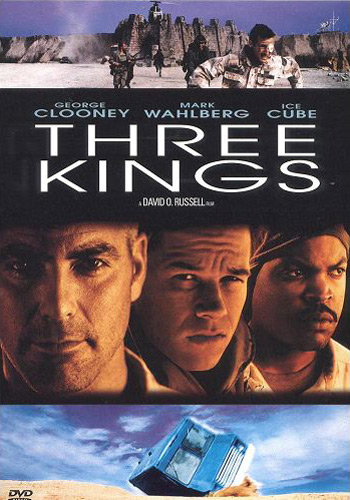
Three Kings: Neocolonial Arab Representation


This critical essay of the movie the Three Kings was written by Lila Kitaeff, who is a writer for Jump Cut. Kitaeff discusses how David O. Russell's film represents Arabs in his movie. In the article, Kitaeff first talks about how Arabs are stereotyped in America through the media, military, politics, and even through our economy. Here is an excerpt from her article dealing with this:
In both popular culture and government policy, anit-Arab stereotypes since the 1970's have affixed a stigma on Arab ethnicity in America...The Arab as villain has been a favorite scape-goat of American culture.
Kitaeff then goes on to discuss how Arabs are looked at in this was in the Three Kings by showing the movie through the American soldiers eyes, and by having the American soldiers be the heroes. However, in the next part of the essay, Kitaeff does show the other side to this argument as well. Here's another sample quote:
This same reviewer even suggested that the film addressed 'the amorality and lack of consistent principles in American foreign policy. No Hollywood film in memory has addressed such an issue.'"
I think everyone should read this essay not only because it is interesting, but because it is great to look at to get ideas for our final project.

Sunday, March 25, 2007

First Persian Gulf War in Three Kings

This is an excellent article written by Julie Lorenzen. She talks about how the Persian Gulf War was used as the bigger story in the movie, The Three Kings. She goes on to explain about the events that were happening in America at the time that the movie was released (1999).
Hussein was still in charge of Iraq. There were complaints from American soldiers in the Gulf War were suffering from the side effects of the gases supposedly used by the Iraq army. The filmmakers might have feared that if George W. Bush won the election, he’d try to finish his father’s business in Iraq. The film seemed to be a statement of why we shouldn't’t go back because it chronicled the suffering of the Iraqi people.
Lorenzen goes on to explain the plot of the story, the emotional impact of the story, and the overall role that the American soldiers played in the movie and how the war effected them.
The filmmakers were sympathetic to the Iraqi people and critical of the Bush administration...In conclusion, The Three Kings stood out from the other films because it focused on U.S policy and military rather than on politicians and their staff.
This is an excellent article to read in order to get an idea of what our major project should be like, so I suggest that everyone check this one out.

A Selection of Exclusive Outtakes from an Interview with David Russell


The link above provides readers with an inside look into Russell's mind as a director. Gavin Smith, who is the editor of Film Comment, gives an in-depth interview with the director about two of his movies: Three Kings and I Heart Huckabees. In the interview, Russell goes on to explain the concept behind these two different movies, the meaning of each, how his personal life effected the making of them, and the marketing behind the movies. This was a really interesting article to read because you could really see where Russell got all his ideas and what kind of thinking process he must go through for each and every film he directs. Below are some interesting quotes from the article:
The most boring part of Three Kings to me is the heist and the
gold....I like to let the camera roll and not stop, and talk through lots of different takes. So the actors would forget I'm there....There was really no title I was happy with [talking about I Heart Huckabees]. I stuck with it because I like that it has a Heart in it.
I found this article very interesting so I think everyone should check it out!

Friday, March 16, 2007

Steven Spielberg: Director of Many...


The link provided is to Wikipedia, where it gives an in depth biography of famous director Steven Spielberg. The article goes on to explain,
Spielberg is the most financially successful motion picture director of all time. He has directed and/or produced a number of major box office hits.
It goes on to talk about his life, all the films he has created, and the numerous awards that he has received. Spielberg is best known for films that instills some sort of fear in his audience, where it be aliens, the Holocaust, or man-eating dinosaurs. This type of genre is what Spielberg is into and good at. Because of this, he has received many awards for best director (Schindler's List, 1994), best picture (Schindler's List, 1994) and Best Foreign Language Film (Letters from Iwo Jima) to name a few. Check out this article, it has many interesting bits of information. :)

Sunday, March 11, 2007

History Behind Schindler's List


The link provided gives an in-depth summary of the Holocaust, which is the event that the movie Schindler's List focuses on.
During World War II, Nazi Germany and its collaborators murdered approximately six million Jews. The Holocaust is the name used to refer to this systematic, bureaucratic, and state-sponsored campaign of persecution and murder. Beginning with racially discriminatory laws in Germany, the Nazi campaign expanded to the mass murder of all European Jews.
Schindler's List helps the audience grasp what was going on and tells its story through the perspective of Oscar Schindler and some of the Jews that were captured. For the film Schindler's List, experts on the Holocaust were brought in to make sure the film stayed true to historical facts. The nice aspect about the link I provided is that it lets you click on keys words surrounding the Holocaust and goes into further detail on each of those words. For example, you can click on "concentration camps," and the site will take you to another page that deals only with different concentration camps and how they were used in Schindler's List.

Sunday, March 4, 2007

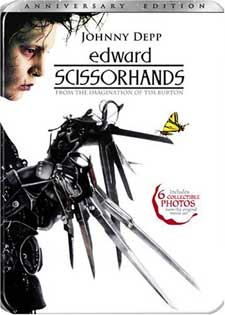
Ideology in Edward Scissorhands


Ann Devine, author of the essay entitled Edward Scissorhands, talks about not only ideology, but also America's culture. She talks a lot about our stereotypes and how the way people treated Edward changes throughout the movie.
Edward is initially treated very kindly (particularly by women) and described in terms such as 'different, mysterious, exceptional'... Suddenly, the very things which rendered him unique (scissorhands) are seen as evidence that he is a
dangerous criminal and unfit to live in 'normal society'.
Devine also brings up the stereotypes in women and men and what their roles in life are. The essay also talks about ideology in the fact that it brigs up racist and prejudice actions taken by the people in Edward's community. Basically, the essay talks about feminist, race, and class studies, which are all mentioned in Corrigan. It's a really interesting article to read so I suggest everyone reads it :)

Sunday, February 18, 2007

Schindler's List: My Father is a Schindler Jew

This article is great for us to use in our major project. The author, Les White, does a great job telling us about many of characteristics Corrigan describes in his book. He talks about cinematography, auteur and gives many different examples. Below are some really good ones that we can use in our final project.White argues that while many liked the black and white cinematography and felt that it was a symbol of the dark events that took place, he feels it took away from the reality of the movie.
“The film’s Holocaust is removed from reality. Yet the Holocaust deserves to be rendered truthfully in all its detail because it challenges and contradicts any advances made by human beings.”
White illustrates this point by giving an example in the movie where the lack of color takes away from the larger picture.
“Without color, the ash from the crematoriums resembles white, purifying snow and not dirty, non-melting ash.”
By only using black and white, White argues that the movie watchers lose some perspective on just how bad the situation was.

Thursday, February 8, 2007

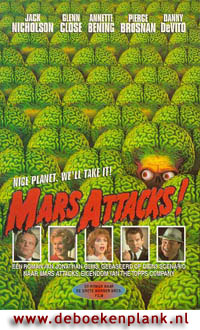
Mars Attacks!

Gary Johnson writes his article about the 1996 crazy, weird and goofy Martians who are trying to take over Earth. Johnson then goes on to explain the Martians,

"Instead of vicious tentacled monsters, we get big-headed, bug-eyed Martians with
ray guns that look exactly like souped-up water pistols."
Johnson explains how the movie was based off of a popular 1962 trading card game entitled Topps. He praises the movie and his only criticism was the fact that it opened around the same time that Independence Day so it was overlooked by many. Johnson considers this movie a gem and applauds Tim Burton for his creative twist on the classical Martians evade Earth plot. The provided link is from Corrigan's Images: Journal of film and popular culture, enjoy!

Casino Royale: Taking a Critical Look

Michael Noble, author of this critical essay starts off by giving a brief summary of the last Bond movie to be released in theaters (Die Another Day). He explains how this set up the newly released film Casino Royale and explains why Bond is so different in this movie. Noble also gives history/background of the previous Bond's portrayed by Sean Connery, Roger Moore, Timothy Dalton, and Pierce Brosnan in hopes of comparing the new Bond, Daniel Craig to the others. In his article, Noble gives Craig high praise for his refreshing role as Bond and to the movie for staying real to Ian Fleming's creation of Bond in his many books. Noble also applauds the more realistic characters and scenes in the movie by saying,
"More Jack Bauer than Austin Powers, Daniel Craig plays James Bond as a spy for our interesting times. With images of real torture beamed nightly into our living rooms, we are a long way from the elaborate castration-by-laser of Goldfinger."
Noble ends his article with a salute to the new James Bond. The link provided goes straight to flakmag, which is where I found the article. Below is the ending paragraph of Noble's article, which I found interesting.
"Bond ends Casino Royale by uttering his most iconic line: "The name's Bond, James Bond." It is fitting that he waits until the end to introduce himself. 007 has come full circle. Yes, the world has changed, but in a way that only makes Fleming's original conception of him more relevant. The real James Bond is back."

Friday, January 26, 2007

Pirates of the Caribbean: Dead Man's Chest

Jerry Bruckheimer and Gore Verbinski team up once again to create the second installment in the Pirates of the Caribbean movies. Jack Sparrow, the clumsy, self-absorbed pirates is back again in a new adventure entitled “Dead Man’s Chest.”This time, he must find the chest of Davy Jones in order to avoid an eternity of misery in the depths of the ocean. Jacks unpaid blood debt doesn’t go over too well with the tortured soul of Davy Jones. So, once again Will and Elizabeth must come to the aid of Jack, which as they are about to find out, isn’t worth it. The link provided has the trailer: enjoy!
http://www.youtube.com/watch?v=30HjlNwYZFc

Wednesday, January 24, 2007

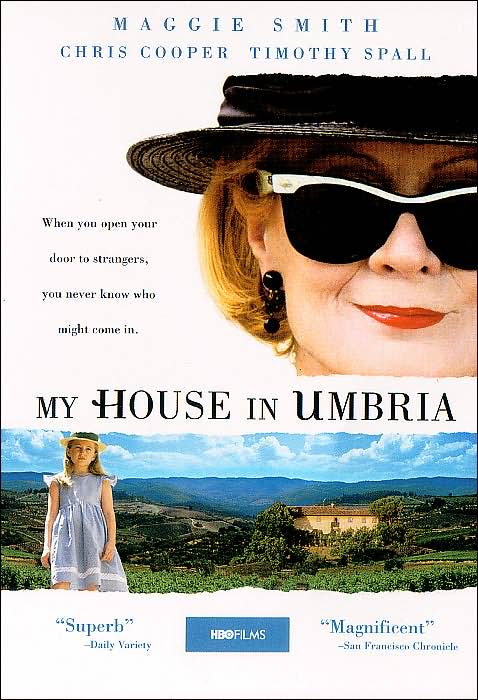
My House in Umbria

"My House in Umbria" is an excellent film to write our final project on because it has most of Corrigan's six methods, plus it's just an excellent movie to watch! After being a victim of a terrorist attack aboard a train, romance writer Mrs. Delahunty invites the survivors from her train compartment to come and recover at her beautiful mansion in the countryside of Umbria. Just as these four strangers start to become close and develop relationships with one another, the uncle of Aimee (who's parents were both killed in the attack), sends word that he is coming to get her. After meeting Aimee's uncle, Mrs. Delahunty does not think that living with him is the ideal situation for Aimee. From there, the story unfolds into Mrs. Delahunty trying to figure out more about this mysterious uncle of Aimee, how to persuade him to let her keep Aimee, and how to continue growing and developing her relationships with the other victims as well. Overall this is simply an excellent film and just as the tagline says: When you open your door to strangers, you never know who might come in.