Showing posts with label tarantino. Show all posts

Friday, May 4, 2007

The Quentin Tarantino Effect

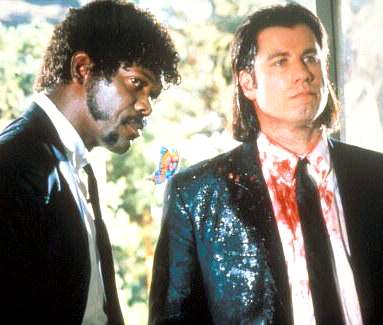
Samuel Jackson and John Travolta in Pulp Fiction

In this article by Stanley Crouch, Quentin Tarantino is viewed as the leading young filmmakers of his time. Tarantino's movies, such as Natural Born Killers, Pulp Fiction, Reservoir Dogs, True Romance, and Jackie Brown, hard-edged, ultra violence with shots of absurd and unexpected humor. Crouch sees Quentin as adding new energy, cool, comedy, and irony, to a low age in movies.

Some of Quentin's use of irony is discussed my Crouch, who sees Quentin discussing our ethnic identity through many of his movies. Examples are given from Pulp Ficton, Jackie Brown, and Reservoir Dogs. Crouch notices that in Reservoir Dogs, blacks are referred as inferiors by the Caucasian cast, but they talk about how attractive Pam Grier (a famous black actor) is. This ironic racism Tarantino adds continues when the undercover cop's mentor turns out to be a black man.
Those alterations reach far beyond the customary racial cliches that thud upon us frame by frame and the hostile or maudlin soap box oratory that washes all possible eloquence out of dialogue.

Crouch finishes by stating Quentin's film making is recognizable yet unfamiliar: "we feel we've seen it and not seen it before."

Monday, March 19, 2007

Quentin Tarantino Talks with Charlie Rose

This is an actual interview of Quentin Tarantino interviewed by Charlie Rose on his show. The Charlie Rose show broadcasts on WYCC (channel 20) on public access television. In this interview, the director talks about himself and what makes a "tarantino script".

The Tarantino Style

This is a clip from youtube but it is an excellent film as it depicts the style of tarantino using his film like:

"Reservoir Dogs" (1992),
"Pulp Fiction" (1994),
"Jackie Brown" (1997),
"Kill Bill volume 1" (2003) and
"Kill Bill vol. 2" (2004).

The good thing about this film clip is that you can see some parallels about the themes in tarantino's work. For example, in one scene from "Pulp Fiction", we have samuel jackson and travolta looking at the money in the trunk while it compares that to another scene in another tarantino film. The theme might be that there is greed associated with crime which has its implications in tarantino's films. The common themes help us perform an auteur analysis of tarantino's work.

Sunday, March 11, 2007

Events around Pulp Fiction

The movie "Pulp Fiction" was release in 1994. This is the same time that the infamous OJ Simpson trial was taking place in California. The extent to which people were interested in this criminal investigation and trial can be judged from the following quote,

"Although the 1995 criminal trial of O. J. Simpson for the murders of Nicole Brown Simpson and Ronald Goldman has been called "a great trash novel come to life," no one can deny the pull it had on the American public. If the early reports of the murder of the wife of the ex-football-star-turned-sports-announcer hadn't caught people's full attention, Simpson's surreal Bronco ride on the day of his arrest certainly did--ninety-five million television viewers witnessed the slow police chase live. The 133 days of televised courtroom testimony turned countless viewers into Simpson trial junkies. Even foreign leaders such as Margaret Thatcher and Boris Yeltsin eagerly gossiped about the trial. When Yeltsin stepped off his plane to meet President Clinton, the first question he asked was, "Do you think O. J. did it?" When, at 10 a.m. PST on October 3, Judge Ito's clerk read the jury's verdict of "Not Guilty," 91% of all persons viewing television were glued to the unfolding scene in the Los Angeles courtroom."

The movie pulp fiction also deals with crime like the Boss who supposedly killed a guy who massage his wife (Uma Thurman's) feet. But I think the other debate that raged because of the OJ Simpson trial was about race. There are claims that the trial had been tainted by race. If we look closely in the case of Pulp Fiction, we see there are racial overtones that Tarantino has carefully built into the movie. One scene in particular happened when the boss and the boxer (bruce willis) end up in a store in a sequence. The door has the confederate flag on it. But the thing to note in there is the store owner (and his police buddy) sexually assault the boss (a black) but leave alone the character of Bruce Willis. I think what Tarantino might be trying to accomplish by this is to show us that there still are racial barriers that exist between different groups even after all these years.

The author of the website is Douglas O. Linder from the Univ of Missouri - Kansas School of Law.

Whaddya Look at? Re-reading the gangster genre

This movie is talking about the "Godfather" but I think it is relevent since my movie Pulp Fiction is also a gangster crime drama. The article goes character by character of the Sopranos and sees how it all fits in the crime gangster genre that, in this case, Godfather belongs in. The article is written by Martha Nochimson who studies the gangster genre in Hollywood. The article is linked from the JSTOR database available through the UIC library.

The following quote from the beginning of the article very nicely tries to sum up the gangster genre:
"Perceived as hypermasculine fare, the gangster picture is generally understood to be popular because of its explosive virility and its close connection to reality. Yet despite these entrenched truisms, hindsight and the progeny that have been spawned by the early masterpieces of the genre suggest that the situation is more complex."

Sunday, February 25, 2007

Formalism in "Pulp Fiction"

In this link Jonanthan L. Bowen gives a review of "Pulp Fiction," but gives more of a formalist view on the film. He talks about the opening scenes and how Tarantino uses the same scence to open the film and also end with. Bowen gives details to the different shots that Tarantino uses and what kind of effect it has on the film. It is a good formalist review, but at the same time describes the what the film is about. "Much like Citizen Kane, Tarantino's techniques in Pulp Fiction are not totally new, unique inventions, but the way he combines numerous unusual elements into a single production makes the film simply unlike any movie viewers had seen previously." Enjoy! Photobucket - Video and Image Hosting

Monday, February 19, 2007

Pulp Fiction

The author is Dr. Alan A. Stone who is the Touroff-Glueck Professor of Law and Psychiatry in the Faculty of Law and the Faculty of Medicine, Harvard University. He has talked about the violence and other plot angles of the movie that affect us psychologically. The article talks about the view that movies like Pulp Fiction are thought to be promoting violence by arguing that the movie is not just about violence but has a plot structure of its own. Basically, Tarantino's movies have much more deeper meaning than what is being perceived by many people.

This below quote is one of the most important quotes in the article. It gives us an idea as to how this name of "Pulp Fiction" might have come about;

"The title "Pulp Fiction" refers, of course, to the pop literary genre of the hard-nosed private investigator, which peaked in the 1930s and 1940s with the work of Dashiell Hammett, Raymond Chandler, and James M. Cain. Newsstands of their era bulged with monthly pulp fiction magazines that vied for the reader's attention with stories that began luridly on the cover and jumped to the back. Tarantino echoes this structure in his film, which opens with one short story, then breaks to two others."

The link is from the AccessMyLibrary website which you can access using your UIC library card or your local public library card. Alternatively, you can also register at their site for free access.

Monday, February 12, 2007

Pulp Fiction


The film initiates with two small-time thieves, Honey Bunny and Pumpkin, who spontaneously decide to hold up a restaurant. The film then shifts to the story of Jules and Vincent, who hit men for the well known and feared Marsellus Wallace, who is caught up in a deal gone wrong with struggling boxer Butch Coolidge.

The movie shows that tarantino is a genius. His idea of using narrative based action instead of things going in chronological order has since been copied by famous movies like Memento. But the biggest art of Tarantino is how he was able to let his character's evolve over the course of the film even though there were four different stories in the film, all connected to each other in different ways.

I think this quote best sums it up,
Back to the dialogue. It is the driving force of the film,

complementing the plot and allowing its characters to grow on us in

ways we never imagined they would. It's the way in which the dialogue

is deliberated that varies from most other examples of deliberation. ...

There are different levels of dialogue -- plot-driven, and realistic

-- but all dialogue is in service of its plot, just as all of what we

say to our friends or family has a deeper meaning and will no doubt

relate to the matter at hand. All dialogue relates to a larger scheme,

and so does the dialogue in "Pulp Fiction."


This is a link to the critical review:
http://us.imdb.com/Reviews/374/37494

Sunday, February 11, 2007

"I am gonna kill Bill!" A Critical Look


In this critical look at Quentin Tarantino's movie, "Kill Bill, Vol. 2," Gary Johnson finds a simplistic theme in the movie best summed up by the title of the movie. In the second installment, The Bride, as her character is known, goes after the other half of assassins who killed her fiancé and left her for dead. Her ultimate goal is revenge against Bill, the man responsible. Johnson says that Tarantino's abilities lie in his contradictions, "to value carnage in one scene and to value the spoken word in the next." Making the movie special, Johnson says, is his unique camera angles, images and overly simplistic plot, though the characters become more developed. For more information the link above is will connect you to Johnson's article on Imagesjournal.com.

Monday, January 22, 2007

Jackie Brown: A Tarantino Masterpiece


Jackie Brown was directed by Quentin Tarantino and features a star-studded cast. While it's probably Tarantino's most underrated film, I feel that Jackie Brown is a great movie and it's my personal favorite. Considering that this is a Tarantino film, most would probably say that it's a good candidate. If a person wanted to write in the "formalist" style, they could talk about the cool and unique shots that were used throughout the movie. As with all Tarantino movies, the soundtrack would definitely be a key part in an approach of that style. The "auteur" approach would be great because the writer could cite such movies as Reservoir Dogs, Pulp Fiction, and Kill Bill.


The link that I have included gives some interesting facts about the movie and provides some cool pictures. The other link that I am providing gives some more information on the legend that is Quentin Tarantino. http://en.wikipedia.org/wiki/Quentin_Tarantino


This is my favorite scene from the movie, so I hope you enjoy it as much as I do. Here we can see Tarantino's ability to combine comedy with seriousness.