Showing posts with label pulp fiction. Show all posts

Friday, May 4, 2007

The Quentin Tarantino Effect

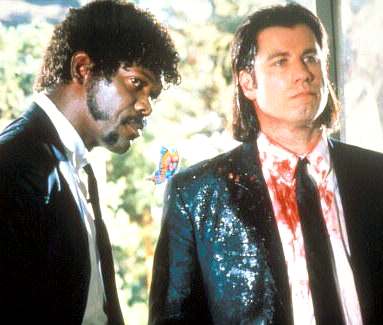
Samuel Jackson and John Travolta in Pulp Fiction

In this article by Stanley Crouch, Quentin Tarantino is viewed as the leading young filmmakers of his time. Tarantino's movies, such as Natural Born Killers, Pulp Fiction, Reservoir Dogs, True Romance, and Jackie Brown, hard-edged, ultra violence with shots of absurd and unexpected humor. Crouch sees Quentin as adding new energy, cool, comedy, and irony, to a low age in movies.

Some of Quentin's use of irony is discussed my Crouch, who sees Quentin discussing our ethnic identity through many of his movies. Examples are given from Pulp Ficton, Jackie Brown, and Reservoir Dogs. Crouch notices that in Reservoir Dogs, blacks are referred as inferiors by the Caucasian cast, but they talk about how attractive Pam Grier (a famous black actor) is. This ironic racism Tarantino adds continues when the undercover cop's mentor turns out to be a black man.
Those alterations reach far beyond the customary racial cliches that thud upon us frame by frame and the hostile or maudlin soap box oratory that washes all possible eloquence out of dialogue.

Crouch finishes by stating Quentin's film making is recognizable yet unfamiliar: "we feel we've seen it and not seen it before."

Sunday, March 11, 2007

Events around Pulp Fiction

The movie "Pulp Fiction" was release in 1994. This is the same time that the infamous OJ Simpson trial was taking place in California. The extent to which people were interested in this criminal investigation and trial can be judged from the following quote,

"Although the 1995 criminal trial of O. J. Simpson for the murders of Nicole Brown Simpson and Ronald Goldman has been called "a great trash novel come to life," no one can deny the pull it had on the American public. If the early reports of the murder of the wife of the ex-football-star-turned-sports-announcer hadn't caught people's full attention, Simpson's surreal Bronco ride on the day of his arrest certainly did--ninety-five million television viewers witnessed the slow police chase live. The 133 days of televised courtroom testimony turned countless viewers into Simpson trial junkies. Even foreign leaders such as Margaret Thatcher and Boris Yeltsin eagerly gossiped about the trial. When Yeltsin stepped off his plane to meet President Clinton, the first question he asked was, "Do you think O. J. did it?" When, at 10 a.m. PST on October 3, Judge Ito's clerk read the jury's verdict of "Not Guilty," 91% of all persons viewing television were glued to the unfolding scene in the Los Angeles courtroom."

The movie pulp fiction also deals with crime like the Boss who supposedly killed a guy who massage his wife (Uma Thurman's) feet. But I think the other debate that raged because of the OJ Simpson trial was about race. There are claims that the trial had been tainted by race. If we look closely in the case of Pulp Fiction, we see there are racial overtones that Tarantino has carefully built into the movie. One scene in particular happened when the boss and the boxer (bruce willis) end up in a store in a sequence. The door has the confederate flag on it. But the thing to note in there is the store owner (and his police buddy) sexually assault the boss (a black) but leave alone the character of Bruce Willis. I think what Tarantino might be trying to accomplish by this is to show us that there still are racial barriers that exist between different groups even after all these years.

The author of the website is Douglas O. Linder from the Univ of Missouri - Kansas School of Law.

Whaddya Look at? Re-reading the gangster genre

This movie is talking about the "Godfather" but I think it is relevent since my movie Pulp Fiction is also a gangster crime drama. The article goes character by character of the Sopranos and sees how it all fits in the crime gangster genre that, in this case, Godfather belongs in. The article is written by Martha Nochimson who studies the gangster genre in Hollywood. The article is linked from the JSTOR database available through the UIC library.

The following quote from the beginning of the article very nicely tries to sum up the gangster genre:
"Perceived as hypermasculine fare, the gangster picture is generally understood to be popular because of its explosive virility and its close connection to reality. Yet despite these entrenched truisms, hindsight and the progeny that have been spawned by the early masterpieces of the genre suggest that the situation is more complex."

Monday, February 19, 2007

Pulp Fiction

The author is Dr. Alan A. Stone who is the Touroff-Glueck Professor of Law and Psychiatry in the Faculty of Law and the Faculty of Medicine, Harvard University. He has talked about the violence and other plot angles of the movie that affect us psychologically. The article talks about the view that movies like Pulp Fiction are thought to be promoting violence by arguing that the movie is not just about violence but has a plot structure of its own. Basically, Tarantino's movies have much more deeper meaning than what is being perceived by many people.

This below quote is one of the most important quotes in the article. It gives us an idea as to how this name of "Pulp Fiction" might have come about;

"The title "Pulp Fiction" refers, of course, to the pop literary genre of the hard-nosed private investigator, which peaked in the 1930s and 1940s with the work of Dashiell Hammett, Raymond Chandler, and James M. Cain. Newsstands of their era bulged with monthly pulp fiction magazines that vied for the reader's attention with stories that began luridly on the cover and jumped to the back. Tarantino echoes this structure in his film, which opens with one short story, then breaks to two others."

The link is from the AccessMyLibrary website which you can access using your UIC library card or your local public library card. Alternatively, you can also register at their site for free access.