Monday, September 29, 2008

Thursday, May 10, 2007
Memoirs of a Geisha

The film Memoirs of a Geisha, is my all time favorite film. It attempts to portray the mentality of a different society, different mentality, as well as a different culture.
Although the director did a wonderful job with the formalist persepective of the film, many were quick to criticize the fact that Chinese actresses and actors portrayed a Japanese fairytale.
''Any doubts about three Chinese actresses speaking English with Japanese accents vanish in the face of their deeply felt performances and the world Marshall conjures with magical finesse,'' said Peter Travers.
This essay dives into stereotypes, nationalism and the acting in the film among other things.
Memoirs of a Geisha
Friday, May 4, 2007
The Quentin Tarantino Effect
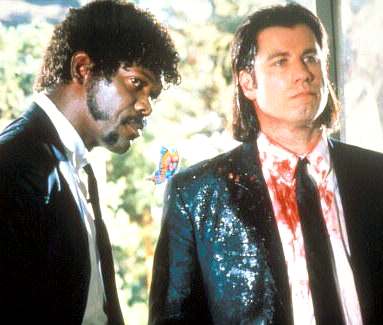 Samuel Jackson and John Travolta in Pulp Fiction
In this article by Stanley Crouch, Quentin Tarantino is viewed as the leading young filmmakers of his time. Tarantino's movies, such as Natural Born Killers, Pulp Fiction, Reservoir Dogs, True Romance, and Jackie Brown, hard-edged, ultra violence with shots of absurd and unexpected humor. Crouch sees Quentin as adding new energy, cool, comedy, and irony, to a low age in movies.
Some of Quentin's use of irony is discussed my Crouch, who sees Quentin discussing our ethnic identity through many of his movies. Examples are given from Pulp Ficton, Jackie Brown, and Reservoir Dogs. Crouch notices that in Reservoir Dogs, blacks are referred as inferiors by the Caucasian cast, but they talk about how attractive Pam Grier (a famous black actor) is. This ironic racism Tarantino adds continues when the undercover cop's mentor turns out to be a black man.
Those alterations reach far beyond the customary racial cliches that thud upon us frame by frame and the hostile or maudlin soap box oratory that washes all possible eloquence out of dialogue.
Crouch finishes by stating Quentin's film making is recognizable yet unfamiliar: "we feel we've seen it and not seen it before."
Science fiction films and religion
Monday, April 30, 2007
300
300
Steven Spielberg's film style
Full Metal Jacket
Lost in Translation: Sophia's Farce??
Does Murray's charisma have to come at the expense of someone else all the
time? (Let's not even talk about the portrayal of the prostitute or the
commercial director.) In a hospital scene, an old lady asks Murray why he took
this long trip to Japan. Murray responds again by playing to the gallery, miming
her as if she were doing a ludicrous choreographed song. He's the odd one out,
the foreigner, and yet he's treating those around him as if they were
foreigners. This is bad manners and bad traveller etiquette. It prompts the
question, is it possible to be American and foreign? I suspect the answer is
'No', at least if one is in an American film, wherever it may be set.The author describes, in great detail, the other actors and actresses and they're strong points and weaknesses in the film. There is also a great deal of ideological analysis which analyzes the socialogical behavior in the film.
Harry Potter and the Goblet of Fire

This is Harry's fourth year at Hogwarts School of Witchcraft and Wizardry. This year he finds himself facing the triwizard tournament as the fourth opponent, which breaks the rules of the tournament. This, however, was not the doing of Harry but of a more sinister force. On can feel the evil in this movie because of all of the darkness in it. Professor Alastor Moody, for example who turns out to be a traitor in disguise, is shrouded in ambiguity as a foreboding that this character would turn out evil. He is consistently dressed in dark colors and in shadows, which signify evil about him. Lord Voldemort himself is always carried in a black cloth which archetypally means death, this is fitting because Voldemort is technically dead; however, he can not die because of precautionary magic used. Albus Percival Wulfric Brian Dumbledore is the exact opposite of Lord Voldemort, he is the Jesus Character in a sense whereas Voldemort would be the devil. Dumbledore is ever omnisicent and is always shrouded in the light which is an archetype for goodness. The Gryffindors colors are crimson and yellow, crimson being a color that indicates passion which tends to be true for the greater majority if not all of the gryffindors. The gray in the colors of the Slytherins represents ambiguity because one is not born evil, one is made that way. In this case it more specifically represents their stuggle of children to try to live up ti the expectations of their parent,wheter they want to or not.
spiderman ideological analysis

Hulk


Terminator
Both movies involve cyborgs that eventually take over the world in the future. Also, both movies have a cyborg go back into the past to right a wrong and save the world. It seems to me that James Cameron took his entire concept of Terminator right from this film.
In Cyborg 2087, a cyborg that is not controlled by the rest of the cyborgs is sent back in time to make sure that a scientist named Dr. Marx destroyed his new technology. This technology allows one person to take control of everyone else in the world. This in turn makes the future a place where no one is able to think freely.
In Terminator, a cyborg is sent into the past to make sure Sarah Connor stays alive. She is to produce a child that keeps the world in check.
Sunday, April 29, 2007
"The Gun, the Pen, and the Cannoli: Orality and Writing in The Godfather, Part 1
The authors mention how many people have discussed how The Godfather deals with capitalism. These authors agree, and will examine capitalism using " 'orality,' which stands for the gift economy, and 'writing,' which stands for capitalism and its legal arm." They use three scenes to defend their claim. The first scene is the wedding scene, which is the beginning of the movie.
The opening sentence examining the wedding scene states, "In the opening wedding scene, the symbolism of writing and food establishes a stark contrast between American and Sicilian society." The American society is exemplified through the writing aspect, where as Sicilian society is represented through orality. One example used is the way the FBI agents are writing down license plate numbers on notepads, and use their FBI identification cards as authority. Another major example the authors mention from the wedding scene of the movie is when Michael Corleone tells his girlfriend the story about the Don making a bandleader "an offer he can't refuse." It is explained how a written contract is used to trap the Don's singing star godson, but a gun held to his head by Luca Brasi over rules the contract. This is a direct contrast between writing and orality. To clarify, the authors state, "Moreover, his style of power is different. Whereas the state's power is abstract (based on laws), mediated (communicated through writing, not through face to face interaction), and supposedly inflexible (tied to the letter of the law), the Don's power is physical (the gun tot he head), personal (the Godfather-godson relationship), and flexible (allows for changes in circumstances)."
Other example from the wedding scene are seen in the Godfather's office, and how he "forms bonds with his supporters." His two guests, the undertaker, and the baker are compared as one follows American society and the other Sicilian society. Bonasera is explained to represent American society because when he asks a favor of the Don, he doesn't approach him as a friend, and offers money for the Godfather's service, where as the baker represents Sicilian society because he approaches the Godfather as as a friend, and offers a favor and friendship to the Don in return for a favor from him. The baker says "and wait till you see the beautiful wedding cake I made for your daughter," which is a friend to friend favor rather than a service, according to Wogan and Sutton. Don Corleone appreciates the baker's friendly gesture and treats him kindly, but scolds the undertaker saying "You don't ask with respect. You don't offer friendship. You don't even think to call me Godfather. Instead, you come into my house on the day my daughter is to be married and you, uh, ask me to do murder, for money." The authors relate the orality is related to cake, and friendship between the Don and the baker, whereas the writing is aspect that the money acts a contract between the Don and the undertaker. The undertaker is also said to be related to American society because his first line, and the first line of the movie for that matter is "I believe in America."
I agree with the claims these authors are making and see the relationships relating the American and Sicilian society. However, think the terms orality and writing are misleading, and don't classify all of the examples the authors are mentioning. Two more scenes are examined by the author which are Michael's Murder scene and the Moe Green Casino scene. Each gives similar examples to defend the contrasting claims about American and Sicilian society.
Desperado: A Robert Rodriguez Flick

Tobacco and Alcohol Use in Disney Films!
According to the Journal of American Medical Association, "More than two thirds of animated children's films feature tobacco or alcohol use in story plots without clear verbal messages of any negative long-term health effects associated with use of either substance." The impact of tobacco and alcohol in these G-rated films promotes the use of these substances to its underage viewers. Use of tobacco and alcohol lead to major health problems. In effort to prevent these future health problems, 50 films were reviewed to screen incidents of substance use. According to these screenings,
"34 (68%) displayed at least 1 episode of tobacco or alcohol use. Twenty-eight (56%) portrayed 1 or more incidences of tobacco use, including all 7 films released in 1996 and 1997. Twenty-five films (50%) included alcohol use. Smoking was portrayed on screen by 76 characters for more than 45 minutes in duration; alcohol use was portrayed by 63 characters for 27 minutes. Good characters use tobacco and alcohol as frequently as bad characters. Cigars and wine are shown in these films more often than other tobacco or alcohol substances."
Gurinder Chadha - a british director

Cool Runnings

This film takes an interesting look at couple of track stars turned bobsledders. After failing to qualify for the summer olympics in track, the track stars turn to another event. This event, which is not even part of the summer olympics but instead the winter olympics, would be a first. The group opts to get together a bobsledd team. What's the irony here? This would be the first bobsled team from Jamaica. This film filled with bright colors which consistently express hope is one to watch. Although the film's actual facts for the Jamaican team are altered, one should approuch this film with an ope mind. Made by Disney, Cool Runnings is a film worth watching by any age. Its layed back introduction to its misfortunate ending will keep viewers wanting more.
Gandhi

The film Gandhi was directed by Richard Attenborough in 1982. The film was nominated and received numerous awards such as best picture, best director, and best actor (Ben Kingsley). In a historical perspective, many claimed that the film was historically inaccurate. According to the author of the article, Michael Hofland, many people criticized the portrayal of Mohammed Al Jinnah, a revolutionary in the Muslim world. Jinnah is portrayed as a terrible person, unwilling to create a cooperation between Hindus and Muslims, according to the critics. Hofland states that many people feel that Gandhi had flaws too and was not always right. The critics believe that "the film portrays him basically without a flaw, when it should show his true self." Some say that a large part film is propaganda, but nevertheless, "Gandhi was honored with many Hollywood awards and continues to be a beloved film," states Hofland.
DOOM 3 ANALYSIS
